XLNet: Generalized Auto regressive Pre training for Language Understanding
XLNet: 用于语言理解的广义自回归预训练
Zhilin Yang∗1, Zihang Dai∗12, Yiming Yang1, Jaime Carbonell1, Ruslan Salak hut dino v 1, Quoc V. Le2 1Carnegie Mellon University, 2Google AI Brain Team {zhiliny,dzihang,yiming,jgc,rsalakhu}@cs.cmu.edu, qvl@google.com
Zhilin Yang∗1, Zihang Dai∗12, Yiming Yang1, Jaime Carbonell1, Ruslan Salakhutdinov1, Quoc V. Le2
1卡内基梅隆大学, 2Google AI Brain Team
{zhiliny,dzihang,yiming,jgc,rsalakhu}@cs.cmu.edu, qvl@google.com
Abstract
摘要
With the capability of modeling bidirectional contexts, denoising auto encoding based pre training like BERT achieves better performance than pre training approaches based on auto regressive language modeling. However, relying on corrupting the input with masks, BERT neglects dependency between the masked positions and suffers from a pretrain-finetune discrepancy. In light of these pros and cons, we propose XLNet, a generalized auto regressive pre training method that (1) enables learning bidirectional contexts by maximizing the expected likelihood over all permutations of the factorization order and (2) overcomes the limitations of BERT thanks to its auto regressive formulation. Furthermore, XLNet integrates ideas from Transformer-XL, the state-of-the-art auto regressive model, into pre training. Empirically, under comparable experiment settings, XLNet outperforms BERT on 20 tasks, often by a large margin, including question answering, natural language inference, sentiment analysis, and document ranking.1.
- 基于双向上下文建模的能力,像 BERT 这样的去噪自编码预训练方法比基于自回归语言建模的预训练方法表现更好。然而,由于依赖掩码对输入进行破坏,BERT 忽略了掩码位置之间的依赖关系,并存在预训练-微调差异。鉴于这些优缺点,我们提出了 XLNet,这是一种广义的自回归预训练方法,它 (1) 通过最大化所有因子分解顺序排列的期望似然来学习双向上下文,并且 (2) 由于其自回归公式,克服了 BERT 的局限性。此外,XLNet 将来自最先进的自回归模型 Transformer-XL 的思想整合到预训练中。实验表明,在可比的实验设置下,XLNet 在 20 个任务上优于 BERT,通常优势显著,包括问答、自然语言推理、情感分析和文档排序。
1 Introduction
1 引言
Unsupervised representation learning has been highly successful in the domain of natural language processing [7, 22, 27, 28, 10]. Typically, these methods first pretrain neural networks on large-scale unlabeled text corpora, and then finetune the models or representations on downstream tasks. Under this shared high-level idea, different unsupervised pre training objectives have been explored in literature. Among them, auto regressive (AR) language modeling and auto encoding (AE) have been the two most successful pre training objectives.
无监督表示学习在自然语言处理领域取得了巨大成功 [7, 22, 27, 28, 10]。通常,这些方法首先在大规模无标签文本语料库上预训练神经网络,然后在下游任务上微调模型或表示。在这一共享的高层思想下,文献中探索了不同的无监督预训练目标。其中,自回归 (AR) 语言建模和自编码 (AE) 是两种最成功的预训练目标。
AR language modeling seeks to estimate the probability distribution of a text corpus with an auto regressive model [7, 27, 28]. Specifically, given a text sequence $\mathbf{x}=(x_{1},\cdots,x_{T})$ , AR language modeling factorizes the likelihood into a forward product $\begin{array}{r}{p(\mathbf{x})=\prod_{t=1}^{T}p(x_{t}\mid\mathbf{x}_{<t})}\end{array}$ or a backward one $\begin{array}{r}{p(\mathbf{x})=\prod_{t=T}^{1}p(x_{t}\mid\mathbf{x}_{>t})}\end{array}$ . A parametric model (e.g. a neural network) is trained to model each conditional distribution. Since an AR language model is only trained to encode a uni-directional context (either forward or backward), it is not effective at modeling deep bidirectional contexts. On the contrary, downstream language understanding tasks often require bidirectional context information. This results in a gap between AR language modeling and effective pre training.
AR 语言建模旨在通过自回归模型估计文本语料库的概率分布 [7, 27, 28]。具体来说,给定一个文本序列 $\mathbf{x}=(x_{1},\cdots,x_{T})$,AR 语言建模将似然分解为前向乘积 $\begin{array}{r}{p(\mathbf{x})=\prod_{t=1}^{T}p(x_{t}\mid\mathbf{x}_{<t})}\end{array}$ 或后向乘积 $\begin{array}{r}{p(\mathbf{x})=\prod_{t=T}^{1}p(x_{t}\mid\mathbf{x}_{>t})}\end{array}$。通过训练一个参数化模型(例如神经网络)来建模每个条件分布。由于 AR 语言模型仅训练用于编码单向上下文(前向或后向),因此在建模深度双向上下文时效果不佳。相反,下游语言理解任务通常需要双向上下文信息。这导致了 AR 语言建模与有效预训练之间的差距。
In comparison, AE based pre training does not perform explicit density estimation but instead aims to reconstruct the original data from corrupted input. A notable example is BERT [10], which has been the state-of-the-art pre training approach. Given the input token sequence, a certain portion of tokens are replaced by a special symbol [MASK], and the model is trained to recover the original tokens from the corrupted version. Since density estimation is not part of the objective, BERT is allowed to utilize bidirectional contexts for reconstruction. As an immediate benefit, this closes the aforementioned bidirectional information gap in AR language modeling, leading to improved performance. However, the artificial symbols like [MASK] used by BERT during pre training are absent from real data at finetuning time, resulting in a pretrain-finetune discrepancy. Moreover, since the predicted tokens are masked in the input, BERT is not able to model the joint probability using the product rule as in AR language modeling. In other words, BERT assumes the predicted tokens are independent of each other given the unmasked tokens, which is oversimplified as high-order, long-range dependency is prevalent in natural language [9].
相比之下,基于自编码器 (Autoencoder, AE) 的预训练并不进行显式的密度估计,而是旨在从损坏的输入中重建原始数据。一个显著的例子是 BERT [10],它一直是预训练方法中的最先进技术。给定输入 Token 序列,BERT 会将一部分 Token 替换为特殊符号 [MASK],并训练模型从损坏的版本中恢复原始 Token。由于密度估计不是目标的一部分,BERT 可以利用双向上下文进行重建。作为直接的好处,这弥补了自回归 (AR) 语言建模中提到的双向信息差距,从而提高了性能。然而,BERT 在预训练期间使用的 [MASK] 等人工符号在微调时的真实数据中并不存在,导致了预训练和微调之间的差异。此外,由于预测的 Token 在输入中被掩码,BERT 无法像 AR 语言建模那样使用乘积规则来建模联合概率。换句话说,BERT 假设在给定未掩码 Token 的情况下,预测的 Token 是相互独立的,这在自然语言中是不现实的,因为高阶、长程依赖关系普遍存在 [9]。
Faced with the pros and cons of existing language pre training objectives, in this work, we propose XLNet, a generalized auto regressive method that leverages the best of both AR language modeling and AE while avoiding their limitations.
面对现有语言预训练目标的优缺点,在本工作中,我们提出了 XLNet,这是一种广义的自回归方法,它结合了自回归语言建模(AR)和自编码(AE)的优点,同时避免了它们的局限性。
• Firstly, instead of using a fixed forward or backward factorization order as in conventional AR models, XLNet maximizes the expected log likelihood of a sequence w.r.t. all possible permutations of the factorization order. Thanks to the permutation operation, the context for each position can consist of tokens from both left and right. In expectation, each position learns to utilize contextual information from all positions, i.e., capturing bidirectional context. • Secondly, as a generalized AR language model, XLNet does not rely on data corruption. Hence, XLNet does not suffer from the pretrain-finetune discrepancy that BERT is subject to. Meanwhile, the auto regressive objective also provides a natural way to use the product rule for factorizing the joint probability of the predicted tokens, eliminating the independence assumption made in BERT.
• 首先,XLNet 不像传统的自回归模型那样使用固定的前向或后向因子化顺序,而是最大化序列在所有可能的因子化顺序下的期望对数似然。得益于排列操作,每个位置的上下文可以包含来自左右两侧的 Token。在期望中,每个位置都能学会利用所有位置的上下文信息,即捕捉双向上下文。
• 其次,作为广义的自回归语言模型,XLNet 不依赖于数据损坏。因此,XLNet 不会受到 BERT 所面临的预训练-微调差异的影响。同时,自回归目标还提供了一种自然的方式,使用乘积规则来分解预测 Token 的联合概率,从而消除了 BERT 中的独立性假设。
In addition to a novel pre training objective, XLNet improves architectural designs for pre training.
除了新颖的预训练目标外,XLNet 还改进了预训练的架构设计。
• Inspired by the latest advancements in AR language modeling, XLNet integrates the segment recurrence mechanism and relative encoding scheme of Transformer-XL [9] into pre training, which empirically improves the performance especially for tasks involving a longer text sequence. • Naively applying a Transformer(-XL) architecture to permutation-based language modeling does not work because the factorization order is arbitrary and the target is ambiguous. As a solution, we propose to re parameter ize the Transformer(-XL) network to remove the ambiguity.
• 受到 AR 语言建模最新进展的启发,XLNet 将 Transformer-XL [9] 的分段循环机制和相对编码方案整合到预训练中,这在经验上提高了性能,尤其是对于涉及较长文本序列的任务。
• 直接将 Transformer(-XL) 架构应用于基于排列的语言建模是行不通的,因为分解顺序是任意的,目标也是模糊的。作为解决方案,我们提出对 Transformer(-XL) 网络进行重新参数化,以消除这种模糊性。
Empirically, under comparable experiment setting, XLNet consistently outperforms BERT [10] on a wide spectrum of problems including GLUE language understanding tasks, reading comprehension tasks like SQuAD and RACE, text classification tasks such as Yelp and IMDB, and the ClueWeb09-B document ranking task.
实验表明,在可比的实验设置下,XLNet 在一系列问题上始终优于 BERT [10],包括 GLUE 语言理解任务、阅读理解任务(如 SQuAD 和 RACE)、文本分类任务(如 Yelp 和 IMDB)以及 ClueWeb09-B 文档排序任务。
Related Work The idea of permutation-based AR modeling has been explored in [32, 12], but there are several key differences. Firstly, previous models aim to improve density estimation by baking an “orderless” inductive bias into the model while XLNet is motivated by enabling AR language models to learn bidirectional contexts. Technically, to construct a valid target-aware prediction distribution, XLNet incorporates the target position into the hidden state via two-stream attention while previous permutation-based AR models relied on implicit position awareness inherent to their MLP architectures. Finally, for both orderless NADE and XLNet, we would like to emphasize that “orderless” does not mean that the input sequence can be randomly permuted but that the model allows for different factorization orders of the distribution.
相关工作
基于排列的自回归(AR)建模思想在 [32, 12] 中已有探讨,但存在几个关键差异。首先,之前的模型旨在通过将“无序”的归纳偏差融入模型中来改进密度估计,而 XLNet 的动机是使自回归语言模型能够学习双向上下文。从技术上讲,为了构建有效的目标感知预测分布,XLNet 通过双流注意力将目标位置纳入隐藏状态,而之前的基于排列的自回归模型则依赖于其 MLP 架构中固有的隐式位置感知。最后,对于无序 NADE 和 XLNet,我们想强调的是,“无序”并不意味着输入序列可以随机排列,而是模型允许分布的不同分解顺序。
Another related idea is to perform auto regressive denoising in the context of text generation [11], which only considers a fixed order though.
另一个相关的想法是在文本生成的背景下执行自回归去噪 [11],尽管它只考虑固定的顺序。
2 Proposed Method
2 提出的方法
2.1 Background
2.1 背景
In this section, we first review and compare the conventional AR language modeling and BERT for language pre training. Given a text sequence $\mathbf{x}=[x_{1},\cdots,x_{T}]$ , AR language modeling performs pre training by maximizing the likelihood under the forward auto regressive factorization:
在本节中,我们首先回顾并比较了传统的自回归(AR)语言建模和BERT用于语言预训练的方法。给定一个文本序列 $\mathbf{x}=[x_{1},\cdots,x_{T}]$,自回归语言建模通过最大化前向自回归分解下的似然来进行预训练:

where $h_{\theta}(\mathbf{x}_{1:t-1})$ is a context representation produced by neural models, such as RNNs or Transformers, and $e(x)$ denotes the embedding of $x$ . In comparison, BERT is based on denoising auto-encoding. Specifically, for a text sequence $\mathbf{x}$ , BERT first constructs a corrupted version $\hat{\bf x}$ by randomly setting a portion (e.g. $15%$ ) of tokens in $\mathbf{x}$ to a special symbol [MASK]. Let the masked tokens be $\bar{\bf x}$ . The training objective is to reconstruct $\bar{\bf x}$ from $\hat{\bf x}$ :
其中 $h_{\theta}(\mathbf{x}_{1:t-1})$ 是由神经网络模型(如 RNN 或 Transformer)生成的上下文表示,$e(x)$ 表示 $x$ 的嵌入。相比之下,BERT 基于去噪自编码。具体来说,对于文本序列 $\mathbf{x}$,BERT 首先通过随机将 $\mathbf{x}$ 中的一部分(例如 $15%$)的 token 设置为特殊符号 [MASK] 来构建一个损坏版本 $\hat{\bf x}$。设被掩码的 token 为 $\bar{\bf x}$。训练目标是从 $\hat{\bf x}$ 重建 $\bar{\bf x}$:

where $m_{t}=1$ indicates $x_{t}$ is masked, and $H_{\theta}$ is a Transformer that maps a length $T$ text sequence $\mathbf{x}$ into a sequence of hidden vectors $H_{\boldsymbol\theta}({\bf x})=[H_{\boldsymbol\theta}({\bf x})_{1},H_{\boldsymbol\theta}({\bf x})_{2},\cdot\cdot\cdot~,\bar{H_{\boldsymbol\theta}}({\bf x})_{T}]$ . The pros and cons of the two pre training objectives are compared in the following aspects:
其中 $m_{t}=1$ 表示 $x_{t}$ 被掩码,$H_{\theta}$ 是一个将长度为 $T$ 的文本序列 $\mathbf{x}$ 映射为隐藏向量序列 $H_{\boldsymbol\theta}({\bf x})=[H_{\boldsymbol\theta}({\bf x})_{1},H_{\boldsymbol\theta}({\bf x})_{2},\cdot\cdot\cdot~,\bar{H_{\boldsymbol\theta}}({\bf x})_{T}]$ 的 Transformer。两种预训练目标的优缺点在以下几个方面进行了比较:
• Independence Assumption: As emphasized by the $\approx$ sign in Eq. (2), BERT factorizes the joint conditional probability $p(\bar{\bf x}\mid\hat{\bf x})$ based on an independence assumption that all masked tokens $\bar{\bf x}$ are separately reconstructed. In comparison, the AR language modeling objective (1) factorizes $p_{\boldsymbol{\theta}}(\mathbf{x})$ using the product rule that holds universally without such an independence assumption. • Input noise: The input to BERT contains artificial symbols like [MASK] that never occur in downstream tasks, which creates a pretrain-finetune discrepancy. Replacing [MASK] with original tokens as in [10] does not solve the problem because original tokens can be only used with a small probability — otherwise Eq. (2) will be trivial to optimize. In comparison, AR language modeling does not rely on any input corruption and does not suffer from this issue. • Context dependency: The AR representation $h_{\theta}(\mathbf{x}{1:t-1})$ is only conditioned on the tokens up to position $t$ (i.e. tokens to the left), while the BERT representation $H{\boldsymbol\theta}(\mathbf{x})_{t}$ has access to the contextual information on both sides. As a result, the BERT objective allows the model to be pretrained to better capture bidirectional context.
• 独立性假设:如公式 (2) 中的 $\approx$ 符号所强调的,BERT 基于独立性假设对联合条件概率 $p(\bar{\bf x}\mid\hat{\bf x})$ 进行分解,假设所有被掩码的 token $\bar{\bf x}$ 都是单独重建的。相比之下,AR 语言建模目标 (1) 使用乘积规则对 $p_{\boldsymbol{\theta}}(\mathbf{x})$ 进行分解,该规则普遍成立,无需此类独立性假设。
• 输入噪声:BERT 的输入包含像 [MASK] 这样在下游任务中永远不会出现的人工符号,这导致了预训练与微调之间的差异。如 [10] 中所述,用原始 token 替换 [MASK] 并不能解决问题,因为原始 token 只能以很小的概率使用——否则公式 (2) 将变得过于简单而无法优化。相比之下,AR 语言建模不依赖于任何输入破坏,因此不会受到此问题的影响。
• 上下文依赖性:AR 表示 $h_{\theta}(\mathbf{x}{1:t-1})$ 仅依赖于位置 $t$ 之前的 token(即左侧的 token),而 BERT 表示 $H{\boldsymbol\theta}(\mathbf{x})_{t}$ 可以访问两侧的上下文信息。因此,BERT 目标允许模型在预训练时更好地捕捉双向上下文。
2.2 Objective: Permutation Language Modeling
2.2 目标:排列语言建模
According to the comparison above, AR language modeling and BERT possess their unique advantages over the other. A natural question to ask is whether there exists a pre training objective that brings the advantages of both while avoiding their weaknesses.
根据上述比较,自回归 (AR) 语言建模和 BERT 各自具有独特的优势。一个自然的问题是,是否存在一种预训练目标,能够结合两者的优势,同时避免它们的弱点。
Borrowing ideas from orderless NADE [32], we propose the permutation language modeling objective that not only retains the benefits of AR models but also allows models to capture bidirectional contexts. Specifically, for a sequence $\mathbf{x}$ of length $T$ , there are $T!$ different orders to perform a valid auto regressive factorization. Intuitively, if model parameters are shared across all factorization orders, in expectation, the model will learn to gather information from all positions on both sides.
借鉴无序 NADE [32] 的思想,我们提出了排列语言建模目标,该目标不仅保留了自回归 (AR) 模型的优势,还允许模型捕捉双向上下文。具体来说,对于一个长度为 $T$ 的序列 $\mathbf{x}$,有 $T!$ 种不同的顺序来执行有效的自回归分解。直观上,如果模型参数在所有分解顺序之间共享,那么在期望中,模型将学会从两侧的所有位置收集信息。
To formalize the idea, let $\mathcal{Z}{T}$ be the set of all possible permutations of the length $T$ index sequence $[1,2,\ldots,T]$ . We use $z{t}$ and $\mathbf{z}{<t}$ to denote the $t$ -th element and the first $t-1$ elements of a permutation $\mathbf{z}\in\mathcal{Z}{T}$ . Then, our proposed permutation language modeling objective can be expressed as follows:
为了形式化这一想法,设 $\mathcal{Z}{T}$ 为长度为 $T$ 的索引序列 $[1,2,\ldots,T]$ 的所有可能排列的集合。我们用 $z{t}$ 和 $\mathbf{z}{<t}$ 分别表示排列 $\mathbf{z}\in\mathcal{Z}{T}$ 的第 $t$ 个元素和前 $t-1$ 个元素。然后,我们提出的排列语言建模目标可以表示如下:

Essentially, for a text sequence $\mathbf{x}$ , we sample a factorization order $\mathbf{z}$ at a time and decompose the likelihood $p_{\boldsymbol{\theta}}(\mathbf{x})$ according to factorization order. Since the same model parameter $\theta$ is shared across all factorization orders during training, in expectation, $x_{t}$ has seen every possible element $x_{i}\neq x_{t}$ in the sequence, hence being able to capture the bidirectional context. Moreover, as this objective fits into the AR framework, it naturally avoids the independence assumption and the pretrain-finetune discrepancy discussed in Section 2.1.
本质上,对于文本序列 $\mathbf{x}$,我们每次采样一个分解顺序 $\mathbf{z}$,并根据分解顺序分解似然 $p_{\boldsymbol{\theta}}(\mathbf{x})$。由于在训练过程中所有分解顺序共享相同的模型参数 $\theta$,因此在期望中,$x_{t}$ 已经看到了序列中的每个可能的元素 $x_{i}\neq x_{t}$,从而能够捕捉双向上下文。此外,由于这一目标符合自回归 (AR) 框架,它自然地避免了第 2.1 节中讨论的独立性假设和预训练-微调差异。
Remark on Permutation The proposed objective only permutes the factorization order, not the sequence order. In other words, we keep the original sequence order, use the positional encodings corresponding to the original sequence, and rely on a proper attention mask in Transformers to achieve permutation of the factorization order. Note that this choice is necessary, since the model will only encounter text sequences with the natural order during finetuning.
关于排列的说明
所提出的目标仅对分解顺序进行排列,而非序列顺序。换句话说,我们保持原始序列顺序,使用与原始序列对应的位置编码,并依靠 Transformer 中的适当注意力掩码来实现分解顺序的排列。需要注意的是,这一选择是必要的,因为在微调过程中,模型只会遇到具有自然顺序的文本序列。
To provide an overall picture, we show an example of predicting the token $x_{3}$ given the same input sequence $\mathbf{x}$ but under different factorization orders in the Appendix A.7 with Figure 4.
为了提供一个整体的概览,我们在附录 A.7 中展示了图 4,展示了在给定相同输入序列 $\mathbf{x}$ 但不同分解顺序下预测 token $x_{3}$ 的示例。
2.3 Architecture: Two-Stream Self-Attention for Target-Aware Representations
2.3 架构:用于目标感知表示的双流自注意力机制
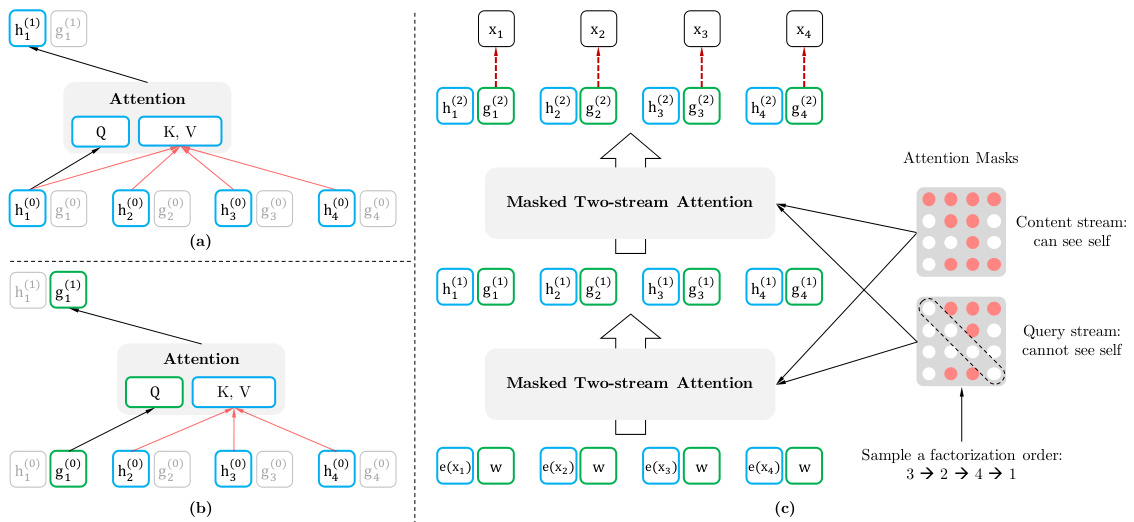
Figure 1: (a): Content stream attention, which is the same as the standard self-attention. (b): Query stream attention, which does not have access information about the content $x_{z_{t}}$ . (c): Overview of the permutation language modeling training with two-stream attention.
图 1: (a): 内容流注意力,与标准的自注意力机制相同。 (b): 查询流注意力,无法访问内容 $x_{z_{t}}$ 的信息。 (c): 使用双流注意力进行排列语言建模训练的概览。
While the permutation language modeling objective has desired properties, naive implementation with standard Transformer parameter iz ation may not work. To see the problem, assume we parameter ize the next-token distribution $p_{\theta}(X_{z_{t}}\mid\mathbf{x}{\mathbf{z}{<t}})$ using the standard Softmax formulation, i.e., $p_{\theta}(X_{z_{t}}=$ $\begin{array}{r}{x\mid\mathbf{x_{z}}_{<t}\big)=\frac{\exp\left(e(x)^{\top}h_{\theta}(\mathbf{x_{z}}_{<t})\right)}{\sum_{x^{\prime}}\exp\left(e(x^{\prime})^{\top}h_{\theta}(\mathbf{x_{z}}_{<t})\right)}}\end{array}$ Pxe′x epx(pe((ex()x′)hθ⊤(hxθz(<xtz)<)t)) , where hθ(xz<t) denotes the hidden representation of xz<t produced by the shared Transformer network after proper masking. Now notice that the representation $\bar{h}_{\theta}(\mathbf{x}_{\mathbf{z}_{<t}})$ does not depend on which position it will predict, i.e., the value of $z_{t}$ . Consequently, the same distribution is predicted regardless of the target position, which is not able to learn useful representations (see Appendix A.1 for a concrete example). To avoid this problem, we propose to re-parameter ize the next-token distribution to be target position aware:
虽然排列语言建模目标具有所需的特性,但使用标准Transformer参数化的简单实现可能无法奏效。为了说明这个问题,假设我们使用标准的Softmax公式来参数化下一个Token的分布 $p_{\theta}(X_{z_{t}}\mid\mathbf{x}{\mathbf{z}{<t}})$ ,即 $p_{\theta}(X_{z_{t}}=$ $\begin{array}{r}{x\mid\mathbf{x_{z}}_{<t}\big)=\frac{\exp\left(e(x)^{\top}h_{\theta}(\mathbf{x_{z}}_{<t})\right)}{\sum_{x^{\prime}}\exp\left(e(x^{\prime})^{\top}h_{\theta}(\mathbf{x_{z}}_{<t})\right)}}\end{array}$ Pxe′x epx(pe((ex()x′)hθ⊤(hxθz(<xtz)<)t)) ,其中 $h_{\theta}(x_{z_{<t}})$ 表示通过适当的掩码处理后,共享Transformer网络生成的 $x_{z_{<t}}$ 的隐藏表示。现在注意到,表示 $\bar{h}_{\theta}(\mathbf{x}_{\mathbf{z}_{<t}})$ 并不依赖于它将预测的位置,即 $z_{t}$ 的值。因此,无论目标位置如何,都会预测相同的分布,这无法学习到有用的表示(具体示例见附录A.1)。为了避免这个问题,我们建议重新参数化下一个Token的分布,使其能够感知目标位置:

where $g_{\theta}\big(\mathbf{x_{z}}{<t},z{t}\big)$ denotes a new type of representations which additionally take the target position $z_{t}$ as input.
其中 $g_{\theta}\big(\mathbf{x_{z}}{<t},z{t}\big)$ 表示一种新型的表示方法,它额外将目标位置 $z_{t}$ 作为输入。
Two-Stream Self-Attention While the idea of target-aware representations removes the ambiguity in target prediction, how to formulate $g_{\theta}\left(\mathbf{x_{z}}{<t},z{t}\right)$ remains a non-trivial problem. Among other possibilities, we propose to “stand” at the target position $z_{t}$ and rely on the position $z_{t}$ to gather information from the context $\mathbf{x_{z}}{<t}$ through attention. For this parameter iz ation to work, there are two requirements that are contradictory in a standard Transformer architecture: (1) to predict the token $x{z_{t}}$ , $g_{\theta}(\mathbf{x_{z}}{<t},z{t})$ should only use the position $z_{t}$ and not the content $x_{z_{t}}$ , otherwise the objective becomes trivial; (2) to predict the other tokens $x_{z_{j}}$ with $j>t$ , $g_{\theta}\big(\mathbf{x_{z}}{<t},z{t}\big)$ should also encode the content $x_{z_{t}}$ to provide full contextual information. To resolve such a contradiction, we propose to use two sets of hidden representations instead of one:
双流自注意力机制
虽然目标感知表示的概念消除了目标预测中的歧义,但如何形式化 $g_{\theta}\left(\mathbf{x_{z}}{<t},z{t}\right)$ 仍然是一个非平凡的问题。在众多可能性中,我们提出“站在”目标位置 $z_{t}$ 上,并依赖位置 $z_{t}$ 通过注意力机制从上下文 $\mathbf{x_{z}}{<t}$ 中收集信息。为了使这种参数化方法有效,标准 Transformer 架构中存在两个相互矛盾的要求:(1) 为了预测 Token $x{z_{t}}$,$g_{\theta}(\mathbf{x_{z}}{<t},z{t})$ 应该仅使用位置 $z_{t}$ 而不使用内容 $x_{z_{t}}$,否则目标将变得微不足道;(2) 为了预测其他 Token $x_{z_{j}}$(其中 $j>t$),$g_{\theta}\big(\mathbf{x_{z}}{<t},z{t}\big)$ 还应编码内容 $x_{z_{t}}$ 以提供完整的上下文信息。为了解决这一矛盾,我们提出使用两组隐藏表示而不是一组:
• The content representation $h_{\theta}(\mathbf{x}{\mathbf{z}{\le t}})$ , or abbreviated as $h_{z_{t}}$ , which serves a similar role to the standard hidden states in Transformer. This representation encodes both the context and $x_{z_{t}}$ itself. • The query representation $g_{\theta}\left(\mathbf{x_{z}}{<t},z{t}\right)$ , or abbreviated as $g_{z_{t}}$ , which only has access to the contextual information $\mathbf{x_{z}}{<t}$ and the position $z{t}$ , but not the content $x_{z_{t}}$ , as discussed above.
• 内容表示 $h_{\theta}(\mathbf{x}{\mathbf{z}{\le t}})$ ,简称为 $h_{z_{t}}$ ,其作用类似于 Transformer 中的标准隐藏状态。该表示编码了上下文和 $x_{z_{t}}$ 本身。
• 查询表示 $g_{\theta}\left(\mathbf{x_{z}}{<t},z{t}\right)$ ,简称为 $g_{z_{t}}$ ,它只能访问上下文信息 $\mathbf{x_{z}}{<t}$ 和位置 $z{t}$ ,而不能访问内容 $x_{z_{t}}$ ,如上所述。
Computationally, the first layer query stream is initialized with a trainable vector, i.e. $g_{i}^{(0)}=w$ , while the content stream is set to the corresponding word embedding, i.e. $h_{i}^{(0)}=e(x_{i})$ . For each self-attention layer $m=1,\ldots,M$ , the two streams of representations are schematically 2 updated with a shared set of parameters as follows (illustrated in Figures 1 (a) and (b)):
在计算上,第一层的查询流使用一个可训练的向量进行初始化,即 $g_{i}^{(0)}=w$,而内容流则设置为对应的词嵌入,即 $h_{i}^{(0)}=e(x_{i})$。对于每个自注意力层 $m=1,\ldots,M$,两个表示流通过共享的参数集进行更新,如下所示(如图 1 (a) 和 (b) 所示):

where Q, K, V denote the query, key, and value in an attention operation [33]. The update rule of the content representations is exactly the same as the standard self-attention, so during finetuning, we can simply drop the query stream and use the content stream as a normal Transformer(-XL). Finally, we can use the last-layer query representation gzt $g_{z_{t}}^{(M)}$ to compute Eq. (4).
其中 Q、K、V 表示注意力操作中的查询 (query)、键 (key) 和值 (value) [33]。内容表示的更新规则与标准的自注意力完全相同,因此在微调期间,我们可以简单地丢弃查询流,并将内容流用作普通的 Transformer(-XL)。最后,我们可以使用最后一层的查询表示 $g_{z_{t}}^{(M)}$ 来计算公式 (4)。
Partial Prediction While the permutation language modeling objective (3) has several benefits, it is a much more challenging optimization problem due to the permutation and causes slow convergence in preliminary experiments. To reduce the optimization difficulty, we choose to only predict the last tokens in a factorization order. Formally, we split $\mathbf{z}$ into a non-target sub sequence $\mathbf{z}{\leq c}$ and a target sub sequence $\mathbf{z}{>c}$ , where $c$ is the cutting point. The objective is to maximize the log-likelihood of the target sub sequence conditioned on the non-target sub sequence, i.e.,
部分预测
虽然排列语言建模目标 (3) 有几个优点,但由于排列的原因,它是一个更具挑战性的优化问题,并且在初步实验中导致收敛速度较慢。为了降低优化难度,我们选择仅预测分解顺序中的最后几个 Token。形式上,我们将 $\mathbf{z}$ 分为非目标子序列 $\mathbf{z}{\leq c}$ 和目标子序列 $\mathbf{z}{>c}$,其中 $c$ 是切割点。目标是最大化在非目标子序列条件下目标子序列的对数似然,即

Note that $\mathbf{z}_{>c}$ is chosen as the target because it possesses the longest context in the sequence given the current factorization order $\mathbf{z}$ . A hyper parameter $K$ is used such that about $1/K$ tokens are selected for predictions; i.e., $\left|\mathbf{z}\right|/(\left|\mathbf{z}\right|-c)\overset{.}{\approx}\bar{K}$ . For unselected tokens, their query representations need not be computed, which saves speed and memory.
注意,$\mathbf{z}_{>c}$ 被选为目标,因为它在给定当前分解顺序 $\mathbf{z}$ 的序列中拥有最长的上下文。使用超参数 $K$,使得大约 $1/K$ 的 Token 被选中用于预测;即 $\left|\mathbf{z}\right|/(\left|\mathbf{z}\right|-c)\overset{.}{\approx}\bar{K}$。对于未选中的 Token,它们的查询表示无需计算,从而节省了速度和内存。
2.4 Incorporating Ideas from Transformer-XL
2.4 融入 Transformer-XL 的思想
Since our objective function fits in the AR framework, we incorporate the state-of-the-art AR language model, Transformer-XL [9], into our pre training framework, and name our method after it. We integrate two important techniques in Transformer-XL, namely the relative positional encoding scheme and the segment recurrence mechanism. We apply relative positional encodings based on the original sequence as discussed earlier, which is straightforward. Now we discuss how to integrate the recurrence mechanism into the proposed permutation setting and enable the model to reuse hidden states from previous segments. Without loss of generality, suppose we have two segments taken from a long sequence s; i.e., $\tilde{\mathbf{x}}=\mathbf{s}_{1:T}$ and $\mathbf{x}=\mathbf{s}_{T+1:2T}$ . Let $\tilde{\mathbf{z}}$ and $\mathbf{z}$ be permutations of $[1\cdots T]$ and $[T+1\cdots2T]$ respectively. Then, based on the permutation $\tilde{\mathbf{z}}$ , we process the first segment, and then cache the obtained content representations $\tilde{\mathbf{h}}^{(m)}$ for each layer $m$ . Then, for the next segment $\mathbf{x}$ , the attention update with memory can be written as
由于我们的目标函数符合自回归(AR)框架,我们将最先进的自回归语言模型 Transformer-XL [9] 纳入我们的预训练框架,并以它命名我们的方法。我们整合了 Transformer-XL 中的两项重要技术,即相对位置编码方案和片段循环机制。我们基于原始序列应用相对位置编码,这一点在前文中已经讨论过,较为直接。现在,我们讨论如何将循环机制整合到所提出的排列设置中,并使模型能够重用前一片段的隐藏状态。不失一般性,假设我们从长序列 s 中取出两个片段,即 $\tilde{\mathbf{x}}=\mathbf{s}_{1:T}$ 和 $\mathbf{x}=\mathbf{s}_{T+1:2T}$。设 $\tilde{\mathbf{z}}$ 和 $\mathbf{z}$ 分别是 $[1\cdots T]$ 和 $[T+1\cdots2T]$ 的排列。然后,基于排列 $\tilde{\mathbf{z}}$,我们处理第一个片段,并缓存每一层 $m$ 获得的内容表示 $\tilde{\mathbf{h}}^{(m)}$。接着,对于下一个片段 $\mathbf{x}$,带有记忆的注意力更新可以写为

where $[.,.]$ denotes concatenation along the sequence dimension. Notice that positional encodings only depend on the actual positions in the original sequence. Thus, the above attention update is independent of $\tilde{\mathbf{z}}$ once the representations $\tilde{\mathbf{h}}^{(m)}$ are obtained. This allows caching and reusing the memory without knowing the factorization order of the previous segment. In expectation, the model learns to utilize the memory over all factorization orders of the last segment. The query stream can be computed in the same way. Finally, Figure 1 (c) presents an overview of the proposed permutation language modeling with two-stream attention (see Appendix A.7 for more detailed illustration).
其中 $[.,.]$ 表示沿序列维度的连接。注意,位置编码仅依赖于原始序列中的实际位置。因此,一旦获得表示 $\tilde{\mathbf{h}}^{(m)}$,上述注意力更新就与 $\tilde{\mathbf{z}}$ 无关。这使得可以在不知道前一段的分解顺序的情况下缓存和重用记忆。在期望中,模型学会利用最后一段的所有分解顺序的记忆。查询流可以以相同的方式计算。最后,图 1 (c) 展示了所提出的带有双流注意力的排列语言建模的概述(更多详细说明见附录 A.7)。
2.5 Modeling Multiple Segments
2.5 多段建模
Many downstream tasks have multiple input segments, e.g., a question and a context paragraph in question answering. We now discuss how we pretrain XLNet to model multiple segments in the auto regressive framework. During the pre training phase, following BERT, we randomly sample two segments (either from the same context or not) and treat the concatenation of two segments as one sequence to perform permutation language modeling. We only reuse the memory that belongs to the same context. Specifically, the input to our model is the same as BERT: [CLS, A, SEP, B, SEP], where “SEP” and “CLS” are two special symbols and “A” and “B” are the two segments. Although we follow the two-segment data format, XLNet-Large does not use the objective of next sentence prediction [10] as it does not show consistent improvement in our ablation study (see Section 3.4).
许多下游任务具有多个输入片段,例如问答中的问题和上下文段落。我们现在讨论如何在自回归框架中对多个片段进行预训练。在预训练阶段,我们遵循BERT的方法,随机采样两个片段(可能来自同一上下文或不同上下文),并将这两个片段的连接作为一个序列进行排列语言建模。我们只重用属于同一上下文的记忆。具体来说,模型的输入与BERT相同:[CLS, A, SEP, B, SEP],其中“SEP”和“CLS”是两个特殊符号,“A”和“B”是两个片段。尽管我们遵循了两片段的数据格式,XLNet-Large并未使用下一句预测的目标 [10],因为它在我们的消融研究中并未显示出一致的改进(见第3.4节)。
Relative Segment Encodings Architecturally, different from BERT that adds an absolute segment embedding to the word embedding at each position, we extend the idea of relative encodings from Transformer-XL to also encode the segments. Given a pair of positions $i$ and $j$ in the sequence, if $i$ and $j$ are from the same segment, we use a segment encoding $\mathbf{s}{i j}=\mathbf{s}{+}$ or otherwise $\mathbf{s}{i j}=\mathbf{s}{-}$ , where $\mathbf{s}{+}$ and $\mathbf{s}{-}$ are learnable model parameters for each attention head. In other words, we only consider whether the two positions are within the same segment, as opposed to considering which specific segments they are from. This is consistent with the core idea of relative encodings; i.e., only modeling the relationships between positions. When $i$ attends to $j$ , the segment encoding $\mathbf{s}{i j}$ is used to compute an attention weight $a{i j}=({\bf q}{i}+{\bf b})^{\top}{\bf s}{i j}$ , where $\mathbf{q}{i}$ is the query vector as in a standard attention operation and $\mathbf{b}$ is a learnable head-specific bias vector. Finally, the value $a{i j}$ is added to the normal attention weight. There are two benefits of using relative segment encodings. First, the inductive bias of relative encodings improves generalization [9]. Second, it opens the possibility of finetuning on tasks that have more than two input segments, which is not possible using absolute segment encodings.
相对分段编码
在架构上,与 BERT 在每个位置的词嵌入上添加绝对分段嵌入不同,我们将 Transformer-XL 中的相对编码思想扩展到分段编码。给定序列中的一对位置 $i$ 和 $j$,如果 $i$ 和 $j$ 来自同一分段,我们使用分段编码 $\mathbf{s}{i j}=\mathbf{s}{+}$,否则使用 $\mathbf{s}{i j}=\mathbf{s}{-}$,其中 $\mathbf{s}{+}$ 和 $\mathbf{s}{-}$ 是每个注意力头的可学习模型参数。换句话说,我们只考虑两个位置是否在同一分段内,而不是考虑它们来自哪个具体分段。这与相对编码的核心思想一致,即只建模位置之间的关系。当 $i$ 关注 $j$ 时,分段编码 $\mathbf{s}{i j}$ 用于计算注意力权重 $a{i j}=({\bf q}{i}+{\bf b})^{\top}{\bf s}{i j}$,其中 $\mathbf{q}{i}$ 是标准注意力操作中的查询向量,$\mathbf{b}$ 是一个可学习的特定头偏置向量。最后,值 $a{i j}$ 被添加到正常的注意力权重中。
使用相对分段编码有两个好处。首先,相对编码的归纳偏差提高了泛化能力 [9]。其次,它为在具有两个以上输入分段的任务上进行微调提供了可能性,而使用绝对分段编码则无法实现这一点。
2.6 Discussion
2.6 讨论
Comparing Eq. (2) and (5), we observe that both BERT and XLNet perform partial prediction, i.e., only predicting a subset of tokens in the sequence. This is a necessary choice for BERT because if all tokens are masked, it is impossible to make any meaningful predictions. In addition, for both BERT and XLNet, partial prediction plays a role of reducing optimization difficulty by only predicting tokens with sufficient context. However, the independence assumption discussed in Section 2.1 disables BERT to model dependency between targets.
比较公式 (2) 和 (5),我们观察到 BERT 和 XLNet 都执行部分预测,即只预测序列中的一部分 Token。对于 BERT 来说,这是一个必要的选择,因为如果所有 Token 都被掩码,就无法做出有意义的预测。此外,对于 BERT 和 XLNet 来说,部分预测通过仅预测具有足够上下文的 Token,起到了降低优化难度的作用。然而,2.1 节中讨论的独立性假设使得 BERT 无法建模目标之间的依赖关系。
To better understand the difference, let’s consider a concrete example [New, York, is, a, city]. Suppose both BERT and XLNet select the two tokens [New, York] as the prediction targets and maximize $\log p(\mathrm{NewYork~}|$ is a city). Also suppose that XLNet samples the factorization order [is, a, city, New, York]. In this case, BERT and XLNet respectively reduce to the following objectives:
为了更好地理解其中的差异,让我们考虑一个具体的例子 [New, York, is, a, city]。假设 BERT 和 XLNet 都选择了两个 Token [New, York] 作为预测目标,并最大化 $\log p(\mathrm{NewYork~}|$ is a city)。同时假设 XLNet 采样了分解顺序 [is, a, city, New, York]。在这种情况下,BERT 和 XLNet 分别简化为以下目标:

Notice that XLNet is able to capture the dependency between the pair (New, York), which is omitted by BERT. Although in this example, BERT learns some dependency pairs such as (New, city) and (York, city), it is obvious that XLNet always learns more dependency pairs given the same target and contains “denser” effective training signals.
注意到 XLNet 能够捕捉到 (New, York) 这对依赖关系,而 BERT 忽略了这一点。尽管在这个例子中,BERT 学习了一些依赖对,例如 (New, city) 和 (York, city),但很明显,在给定相同目标的情况下,XLNet 总是学习到更多的依赖对,并且包含“更密集”的有效训练信号。
For more formal analysis and further discussion, please refer to Appendix A.5.
如需更正式的分析和进一步讨论,请参阅附录 A.5。
3 Experiments
3 实验
3.1 Pre training and Implementation
3.1 预训练与实现
Following BERT [10], we use the Books Corpus [40] and English Wikipedia as part of our pre training data, which have 13GB plain text combined. In addition, we include Giga5 (16GB text) [26], ClueWeb 2012-B (extended from [5]), and Common Crawl [6] for pre training. We use heuristics to aggressively filter out short or low-quality articles for ClueWeb 2012-B and Common Crawl, which results in 19GB and 110GB text respectively. After token iz ation with Sentence Piece [17], we obtain 2.78B, 1.09B, 4.75B, 4.30B, and 19.97B subword pieces for Wikipedia, Books Corpus, Giga5, ClueWeb, and Common Crawl respectively, which are 32.89B in total.
继 BERT [10] 之后,我们使用 Books Corpus [40] 和英文维基百科作为预训练数据的一部分,这些数据共有 13GB 的纯文本。此外,我们还加入了 Giga5 (16GB 文本) [26]、ClueWeb 2012-B (从 [5] 扩展而来) 和 Common Crawl [6] 进行预训练。我们使用启发式方法对 ClueWeb 2012-B 和 Common Crawl 中的短文本或低质量文章进行了严格过滤,分别得到了 19GB 和 110GB 的文本。在使用 Sentence Piece [17] 进行 Token 化后,我们分别从维基百科、Books Corpus、Giga5、ClueWeb 和 Common Crawl 中获得了 2.78B、1.09B、4.75B、4.30B 和 19.97B 的子词片段,总计 32.89B。
Our largest model XLNet-Large has the same architecture hyper parameters as BERT-Large, which results in a similar model size. During pre training, we always use a full sequence length of 512. Firstly, to provide a fair comparison with BERT (section 3.2), we also trained XLNet-Large-wikibooks on Books Corpus and Wikipedia only, where we reuse all pre training hyper-parameters as in the original BERT. Then, we scale up the training of XLNet-Large by using all the datasets described above. Specifically, we train on 512 TPU v3 chips for 500K steps with an Adam weight decay optimizer, linear learning rate decay, and a batch size of 8192, which takes about 5.5 days. It was observed that the model still underfits the data at the end of training. Finally, we perform ablation study (section 3.4) based on the XLNet-Base-wikibooks.
我们最大的模型 XLNet-Large 具有与 BERT-Large 相同的架构超参数,因此模型大小相似。在预训练期间,我们始终使用 512 的完整序列长度。首先,为了与 BERT 进行公平比较(第 3.2 节),我们仅在 Books Corpus 和 Wikipedia 上训练了 XLNet-Large-wikibooks,并重用了原始 BERT 中的所有预训练超参数。然后,我们通过使用上述所有数据集扩展了 XLNet-Large 的训练。具体来说,我们在 512 个 TPU v3 芯片上训练了 500K 步,使用 Adam 权重衰减优化器、线性学习率衰减和 8192 的批量大小,耗时约 5.5 天。观察到模型在训练结束时仍然欠拟合数据。最后,我们基于 XLNet-Base-wikibooks 进行了消融研究(第 3.4 节)。
Since the recurrence mechanism is introduced, we use a bidirectional data input pipeline where each of the forward and backward directions takes half of the batch size. For training XLNet-Large, we set the partial prediction constant $K$ as 6 (see Section 2.3). Our finetuning procedure follows BERT [10] except otherwise specified3. We employ an idea of span-based prediction, where we first sample a length $L\in[1,\cdots,5]$ , and then randomly select a consecutive span of $L$ tokens as prediction targets within a context of $(\Bar{K}L)$ tokens.
由于引入了递归机制,我们使用了一个双向数据输入管道,其中前向和后向各占一半的批量大小。在训练 XLNet-Large 时,我们将部分预测常数 $K$ 设为 6(见第 2.3 节)。除非另有说明,我们的微调过程遵循 BERT [10]。我们采用了一种基于跨度的预测方法,首先采样一个长度 $L\in[1,\cdots,5]$,然后在 $(\Bar{K}L)$ 个 Token 的上下文中随机选择一个连续的 $L$ 个 Token 作为预测目标。
We use a variety of natural language understanding datasets to evaluate the performance of our method. Detailed descriptions of the settings for all the datasets can be found in Appendix A.3.
我们使用多种自然语言理解数据集来评估我们方法的性能。所有数据集的详细设置描述可以在附录 A.3 中找到。
3.2 Fair Comparison with BERT
3.2 与 BERT 的公平比较
Table 1: Fair comparison with BERT. All models are trained using the same data and hyper parameters as in BERT. We use the best of 3 BERT variants for comparison; i.e., the original BERT, BERT with whole word masking, and BERT without next sentence prediction.
| 模型 | SQuAD1.1 | SQuAD2.0 | RACE | MNLI | QNLI | QQP | RTE | SST-2 | MRPC | CoLA | STS-B |
|---|---|---|---|---|---|---|---|---|---|---|---|
| BERT-Large (3次最佳) | 86.7/92.8 | 82.8/85.5 | 75.1 | 87.3 | 93.0 | 91.4 | 74.0 | 94.0 | 88.7 | 63.7 | 90.2 |
| XLNet-Large-wikibooks | 88.2/94.0 | 85.1/87.8 | 77.4 | 88.4 | 93.9 | 91.8 | 81.2 | 94.4 | 90.0 | 65.2 | 91.1 |
表 1: 与 BERT 的公平比较。所有模型均使用与 BERT 相同的数据和超参数进行训练。我们使用 3 种 BERT 变体中的最佳结果进行比较,即原始 BERT、使用全词掩码的 BERT 以及不使用下一句预测的 BERT。
Here, we first compare the performance of BERT and XLNet in a fair setting to decouple the effects of using more data and the improvement from BERT to XLNet. In Table 1, we compare (1) best performance of three different variants of BERT and (2) XLNet trained with the same data and hyper parameters. As we can see, trained on the same data with an almost identical training recipe, XLNet outperforms BERT by a sizable margin on all the considered datasets.
在此,我们首先在公平的设置下比较 BERT 和 XLNet 的性能,以分离使用更多数据的影响以及从 BERT 到 XLNet 的改进。在表 1 中,我们比较了 (1) 三种不同 BERT 变体的最佳性能,以及 (2) 使用相同数据和超参数训练的 XLNet。正如我们所看到的,在几乎相同的训练方案下,使用相同数据训练的 XLNet 在所有考虑的数据集上都显著优于 BERT。
3.3 Comparison with RoBERTa: Scaling Up
Table 2: Comparison with state-of-the-art results on the test set of RACE, a reading comprehension task, and on ClueWeb09-B, a document ranking task. $^*$ indicates using ensembles. $\dagger$ indicates our implementations. “Middle” and “High” in RACE are two subsets representing middle and high school difficulty levels. All BERT, RoBERTa, and XLNet results are obtained with a 24-layer architecture with similar model sizes (aka BERT-Large).
3.3 与 RoBERTa 的对比:扩展规模
| RACE | 准确率 | 初中 | 高中 | 模型 | NDCG@20 | ERR@20 |
|---|---|---|---|---|---|---|
| GPT[28] | 59.0 | 62.9 | 57.4 | DRMM[13] | 24.3 | 13.8 |
| BERT [25] | 72.0 | 76.6 | 70.1 | KNRM [8] | 26.9 | 14.9 |
| BERT+DCMN* [38] | 74.1 | 79.5 | 71.8 | Conv[8] | 28.7 | 18.1 |
| RoBERTa [21] | 83.2 | 86.5 | 81.8 | BERTt | 30.53 | 18.67 |
| XLNet | 85.4 | 88.6 | 84.0 | XLNet | 31.10 | 20.28 |
表 2: 在 RACE 阅读理解任务和 ClueWeb09-B 文档排序任务测试集上与最先进结果的对比。$^*$ 表示使用集成方法。$\dagger$ 表示我们的实现。RACE 中的“初中”和“高中”是两个子集,分别代表初中和高中难度级别。所有 BERT、RoBERTa 和 XLNet 的结果均使用 24 层架构获得,模型大小相似(即 BERT-Large)。
After the initial publication of our manuscript, a few other pretrained models were released such as RoBERTa [21] and ALBERT [19]. Since ALBERT involves increasing the model hidden size from 1024 to 2048/4096 and thus substantially increases the amount of computation in terms of FLOPs, we exclude ALBERT from the following results as it is hard to lead to scientific conclusions. To obtain relatively fair comparison with RoBERTa, the experiment in this section is based on full data and reuses the hyper-parameters of RoBERTa, as described in section 3.1.
在我们的论文初稿发布后,其他一些预训练模型相继发布,例如 RoBERTa [21] 和 ALBERT [19]。由于 ALBERT 涉及将模型的隐藏层大小从 1024 增加到 2048/4096,从而显著增加了计算量(以 FLOPs 为单位),因此我们在以下结果中排除了 ALBERT,因为它难以得出科学的结论。为了与 RoBERTa 进行相对公平的比较,本节实验基于完整数据并重用了 RoBERTa 的超参数,如第 3.1 节所述。
The results are presented in Tables 2 (reading comprehension & document ranking), 3 (question answering), 4 (text classification) and 5 (natural language understanding), where XLNet generally outperforms BERT and RoBERTa. In addition, we make two more interesting observations:
结果展示在表 2 (阅读理解与文档排序)、表 3 (问答)、表 4 (文本分类) 和表 5 (自然语言理解) 中,其中 XLNet 通常优于 BERT 和 RoBERTa。此外,我们还做出了两个有趣的观察:
Table 3: Results on SQuAD, a reading comprehension dataset. † marks our runs with the official code. $^*$ indicates ensembles. $^\ddag$ : We are not able to obtain the test results of our latest model on SQuAD1.1 from the organizers after submitting our result for more than one month, and thus report the results of an older version for the SQuAD1.1 test set.
| SQuAD2.0 | EM | F1 | SQuAD1.1 | EM | F1 |
|---|---|---|---|---|---|
| Devset 结果 (单模型) | |||||
| BERT [10] | 78.98 | 81.77 | BERT [10] | 84.1 | 90.9 |
| RoBERTa [21] | 86.5 | 89.4 | RoBERTa [21] | 88.9 | 94.6 |
| XLNet | 87.9 | 90.6 | XLNet | 89.7 | 95.1 |
| Testset 结果 (单模型, 截至 2019 年 12 月 14 日) | |||||
| BERT [10] | 80.005 | 83.061 | BERT [10] | 85.083 | 91.835 |
| RoBERTa [21] | 86.820 | 89.795 | BERT* [10] | 87.433 | 93.294 |
| XLNet | 87.926 | 90.689 | XLNet | 89.898 | 95.080 |
表 3: SQuAD 阅读理解数据集上的结果。† 表示我们使用官方代码运行的结果。$^*$ 表示集成模型。$^\ddag$: 我们在提交结果一个多月后仍无法从组织者处获得最新模型在 SQuAD1.1 上的测试结果,因此报告了 SQuAD1.1 测试集上旧版本的结果。
Table 4: Comparison with state-of-the-art error rates on the test sets of several text classification datasets. All BERT and XLNet results are obtained with a 24-layer architecture with similar model sizes (aka BERT-Large).
表 4: 在多个文本分类数据集测试集上与最先进错误率的比较。所有 BERT 和 XLNet 的结果均使用 24 层架构获得,模型大小相似(即 BERT-Large)。
| 模型 | IMDB | Yelp-2 | Yelp-5 | DBpedia | AG | Amazon-2 | Amazon-5 |
|---|---|---|---|---|---|---|---|
| CNN [15] | 2.90 | 32.39 | 0.84 | 6.57 | 3.79 | 36.24 | |
| DPCNN [15] | 2.64 | 30.58 | 0.88 | 6.87 | 3.32 | 34.81 | |
| Mixed VAT [31,23] | 4.32 | 一 | 0.70 | 4.95 | 1 | ||
| ULMFiT [14] | 4.6 | 2.16 | 29.98 | 0.80 | 5.01 | 一 | |
| BERT [35] | 4.51 | 1.89 | 29.32 | 0.64 | 2.63 | 34.17 | |
| XLNet | 3.20 | 1.37 | 27.05 | 0.60 | 4.45 | 2.11 | 31.67 |
Table 5: Results on GLUE. $^*$ indicates using ensembles, and $\dagger$ denotes single-task results in a multi-task row. All dev results are the median of 10 runs. The upper section shows direct comparison on dev data and the lower section shows comparison with state-of-the-art results on the public leader board.
| 模型 | MNLI | QNLI | QQP | RTE | SST-2 | MRPC | CoLA | STS-B | WNLI |
|---|---|---|---|---|---|---|---|---|---|
| 单任务单模型在开发集上的表现 | |||||||||
| BERT [2] | 86.6/- | 92.3 | 91.3 | 70.4 | 93.2 | 88.0 | 60.6 | 90.0 | |
| RoBERTa [21] | 90.2/90.2 | 94.7 | 92.2 | 86.6 | 96.4 | 90.9 | 68.0 | 92.4 | |
| XLNet | 90.8/90.8 | 94.9 | 92.3 | 85.9 | 97.0 | 90.8 | 69.0 | 92.5 | |
| 多任务集成在测试集上的表现(截至2019年10月28日的排行榜) | |||||||||
| MT-DNN* [20] | 87.9/87.4 | 96.0 | 89.9 | 86.3 | 96.5 | 92.7 | 68.4 | 91.1 | 89.0 |
| RoBERTa* [21] | 90.8/90.2 | 98.9 | 90.2 | 88.2 | 96.7 | 92.3 | 67.8 | 92.2 | 89.0 |
| XLNet* | 90.9/90.9t | 99.0t | 90.4t | 88.5 | 97.1t | 92.9 | 70.2 | 93.0 | 92.5 |
表 5: GLUE 上的结果。$^*$ 表示使用集成方法,$\dagger$ 表示在多任务行中的单任务结果。所有开发集结果是10次运行的中位数。上半部分展示了在开发数据上的直接比较,下半部分展示了与公开排行榜上最先进结果的比较。
• For explicit reasoning tasks like SQuAD and RACE that involve longer context, the performance gain of XLNet is usually larger. This superiority at dealing with longer context could come from the Transformer-XL backbone in XLNet. • For classification tasks that already have abundant supervised examples such as MNLI (>390K), Yelp $(>560\mathrm{K})$ and Amazon $(>3\mathbf{M})$ , XLNet still lead to substantial gains.
• 对于涉及较长上下文的显式推理任务(如 SQuAD 和 RACE),XLNet 的性能提升通常更大。这种在处理较长上下文时的优势可能来自于 XLNet 的 Transformer-XL 骨干网络。
• 对于已经有大量监督样本的分类任务(如 MNLI (>390K)、Yelp $(>560\mathrm{K})$ 和 Amazon $(>3\mathbf{M})$),XLNet 仍然带来了显著的性能提升。
3.4 Ablation Study
3.4 消融研究
We perform an ablation study to understand the importance of each design choice based on four datasets with diverse characteristics. Specifically, there are three main aspects we hope to study:
我们基于四个具有不同特征的数据集进行了消融研究,以理解每个设计选择的重要性。具体来说,我们希望研究以下三个主要方面:
With these purposes in mind, in Table 6, we compare 6 XLNet-Base variants with different implementation details (rows 3 - 8), the original BERT-Base model (row 1), and an additional Transformer-XL baseline trained with the denoising auto-encoding (DAE) objective used in BERT but with the bidirectional input pipeline (row 2). For fair comparison, all models are based on a 12-layer architecture with the same model hyper-parameters as BERT-Base and are trained on only Wikipedia and the Books Corpus. All results reported are the median of 5 runs.
考虑到这些目的,在表 6 中,我们比较了 6 个具有不同实现细节的 XLNet-Base 变体(第 3 - 8 行)、原始的 BERT-Base 模型(第 1 行)以及一个额外的 Transformer-XL 基线模型(第 2 行),该基线模型使用 BERT 中的去噪自编码 (DAE) 目标进行训练,但使用了双向输入管道。为了公平比较,所有模型都基于 12 层架构,模型超参数与 BERT-Base 相同,并且仅在 Wikipedia 和 Books Corpus 上进行训练。所有报告的结果均为 5 次运行的中位数。
Table 6: The results of BERT on RACE are taken from [38]. We run BERT on the other datasets using the official implementation and the same hyper parameter search space as XLNet. $K$ is a hyper parameter to control the optimization difficulty (see Section 2.3).
| # 模型 | RACE | SQuAD2.0 | MNLI | SST-2 | ||
|---|---|---|---|---|---|---|
| 1 | F1 | EM | m/mm | |||
| 2 | BERT-Base DAE+Transformer-XL | 64.3 65.03 | 76.30 79.56 | 73.66 76.80 | 84.34/84.65 84.88/84.45 | 92.78 92.60 |
| 3 | XLNet-Base (K=7) | 66.05 | 81.33 | 78.46 | 85.84/85.43 | 92.66 |
| 4 | XLNet-Base (K=6) | 66.66 | 80.98 | 78.18 | 85.63/85.12 | 93.35 |
| 5 | - memory | 65.55 | 80.15 | 77.27 | 85.32/85.05 | 92.78 |
| 6 | - span-based pred | 65.95 | 80.61 | 77.91 | 85.49/85.02 | 93.12 |
| 7 | - bidirectional data | 66.34 | 80.65 | 77.87 | 85.31/84.99 | 92.66 |
| 8 | + next-sent pred | 66.76 | 79.83 | 76.94 | 85.32/85.09 | 92.89 |
表 6: BERT 在 RACE 上的结果取自 [38]。我们使用官方实现和与 XLNet 相同的超参数搜索空间在其他数据集上运行 BERT。$K$ 是一个控制优化难度的超参数(见第 2.3 节)。
Examining rows 1 - 4 of Table 6, we can see both Transformer-XL and the permutation LM clearly contribute the superior performance of XLNet over BERT. Moreover, if we remove the memory caching mechanism (row 5), the performance clearly drops, especially for RACE which involves the longest context among the 4 tasks. In addition, rows 6 - 7 show that both span-based prediction and the bidirectional input pipeline play important roles in XLNet. Finally, we unexpectedly find the the next-sentence prediction objective proposed in the original BERT does not necessarily lead to an improvement in our setting. Hence, we exclude the next-sentence prediction objective from XLNet.
观察表 6 的第 1 - 4 行,我们可以看到 Transformer-XL 和排列语言模型 (permutation LM) 都对 XLNet 优于 BERT 的性能做出了贡献。此外,如果我们移除内存缓存机制 (第 5 行),性能明显下降,尤其是在涉及最长上下文的 RACE 任务中。此外,第 6 - 7 行表明,基于跨度的预测 (span-based prediction) 和双向输入管道 (bidirectional input pipeline) 在 XLNet 中都扮演着重要角色。最后,我们意外地发现,原始 BERT 中提出的下一句预测目标 (next-sentence prediction objective) 在我们的设置中并不一定会带来改进。因此,我们在 XLNet 中排除了下一句预测目标。
Finally, we also perform a qualitative study of the attention patterns, which is included in Appendix A.6 due to page limit.
最后,我们还对注意力模式进行了定性研究,由于篇幅限制,该研究包含在附录 A.6 中。
4 Conclusions
4 结论
XLNet is a generalized AR pre training method that uses a permutation language modeling objective to combine the advantages of AR and AE methods. The neural architecture of XLNet is developed to work seamlessly with the AR objective, including integrating Transformer-XL and the careful design of the two-stream attention mechanism. XLNet achieves substantial improvement over previous pre training objectives on various tasks.
XLNet 是一种广义的自回归 (AR) 预训练方法,它使用排列语言建模目标来结合 AR 和自编码 (AE) 方法的优势。XLNet 的神经架构被设计为与 AR 目标无缝协作,包括集成 Transformer-XL 以及精心设计的双流注意力机制。XLNet 在各种任务上相比之前的预训练目标取得了显著改进。
Acknowledgments
致谢
The authors would like to thank Qizhe Xie and Adams Wei Yu for providing useful feedback on the project, Jamie Callan for providing the ClueWeb dataset, Youlong Cheng, Yanping Huang and Shibo Wang for providing ideas to improve our TPU implementation, Chenyan Xiong and Zhuyun Dai for clarifying the setting of the document ranking task. ZY and RS were supported by the Office of Naval Research grant N 000141812861, the National Science Foundation (NSF) grant IIS1763562, the Nvidia fellowship, and the Siebel scholarship. ZD and YY were supported in part by NSF under the grant IIS-1546329 and by the DOE-Office of Science under the grant ASCR #KJ040201.
作者感谢 Qizhe Xie 和 Adams Wei Yu 对项目提供了有益的反馈,感谢 Jamie Callan 提供了 ClueWeb 数据集,感谢 Youlong Cheng、Yanping Huang 和 Shibo Wang 为改进我们的 TPU 实现提供了想法,感谢 Chenyan Xiong 和 Zhuyun Dai 澄清了文档排序任务的设置。ZY 和 RS 得到了海军研究办公室资助 N 000141812861、美国国家科学基金会 (NSF) 资助 IIS1763562、Nvidia 奖学金和 Siebel 奖学金的支持。ZD 和 YY 部分得到了 NSF 资助 IIS-1546329 和美国能源部科学办公室资助 ASCR #KJ040201 的支持。
References
参考文献
A Target-Aware Representation via Two-Stream Self-Attention
通过双流自注意力实现目标感知表示
A.1 A Concrete Example of How Standard LM Parameter iz ation Fails
A.1 标准语言模型参数化失败的具体示例
In this section, we provide a concrete example to show how the standard language model parameterization fails under the permutation objective, as discussed in Section 2.3. Specifically, let’s consider two different permutations $\mathbf{z}^{(1)}$ and $\bar{\mathbf{z}^{(2)}}$ satisfying the following relationship
在本节中,我们提供一个具体示例,展示标准语言模型参数化在排列目标下的失败情况,如第2.3节所述。具体来说,我们考虑两个不同的排列 $\mathbf{z}^{(1)}$ 和 $\bar{\mathbf{z}^{(2)}}$,它们满足以下关系

Then, substituting the two permutations respectively into the naive parameter iz ation, we have
然后,将这两个排列分别代入朴素参数化,我们得到

Effectively, two different target positions $i$ and $j$ share exactly the same model prediction. However, the ground-truth distribution of two positions should certainly be different.
实际上,两个不同的目标位置 $i$ 和 $j$ 共享完全相同的模型预测。然而,两个位置的真实分布显然应该是不同的。
A.2 Two-Stream Attention
A.2 双流注意力机制
Here, we provide the implementation details of the two-stream attention with a Transformer-XL backbone.
在这里,我们提供了基于 Transformer-XL 骨干网络的双流注意力机制的实现细节。
Initial re preset ation:
初始表示:

Cached layer $\cdot m$ content re preset ation (memory) from previous segment: $\tilde{\mathbf{h}}^{(m)}$
缓存层 $\cdot m$ 内容重新表示(记忆)来自前一段:$\tilde{\mathbf{h}}^{(m)}$
For the Transformer-XL layer $m=1,\cdots,M$ , attention with relative positional encoding and position-wise feed-forward are consecutively employed to update the re preset nt at ions:
对于 Transformer-XL 层 $m=1,\cdots,M$,依次使用带有相对位置编码的注意力和位置前馈网络来更新表示:

Target-aware prediction distribution:
目标感知预测分布:

A.3 Datasets
A.3 数据集
A.3.1 RACE Dataset
A.3.1 RACE 数据集
The RACE dataset [18] contains near 100K questions taken from the English exams for middle and high school Chinese students in the age range between 12 to 18, with the answers generated by human experts. This is one of the most difficult reading comprehension datasets that involve challenging reasoning questions. Moreover, the average length of the passages in RACE are longer than 300, which is significantly longer than other popular reading comprehension datasets such as SQuAD [29]. As a result, this dataset serves as a challenging benchmark for long text understanding. We use a sequence length of 512 during finetuning.
RACE 数据集 [18] 包含了近 10 万个问题,这些问题来自中国 12 至 18 岁中学生的英语考试,答案由人类专家生成。这是最难的阅读理解数据集之一,涉及具有挑战性的推理问题。此外,RACE 中的文章平均长度超过 300 个词,显著长于其他流行的阅读理解数据集,如 SQuAD [29]。因此,该数据集是长文本理解的一个具有挑战性的基准。我们在微调时使用了 512 的序列长度。
A.3.2 SQuAD
A.3.2 SQuAD
SQuAD is a large-scale reading comprehension dataset with two tasks. SQuAD1.1 [30] contains questions that always have a corresponding answer in the given passages, while SQuAD2.0 [29] introduces unanswerable questions. To finetune an XLNet on SQuAD2.0, we jointly apply a logistic regression loss for answer ability prediction similar to classification tasks and a standard span extraction loss for question answering [10].
SQuAD 是一个大规模阅读理解数据集,包含两个任务。SQuAD1.1 [30] 包含的问题在给定段落中总是有对应的答案,而 SQuAD2.0 [29] 引入了无法回答的问题。为了在 SQuAD2.0 上微调 XLNet,我们联合应用了类似于分类任务的逻辑回归损失用于答案能力预测,以及标准的跨度提取损失用于问答 [10]。
A.3.3 Text classification Datasets
A.3.3 文本分类数据集
Following previous work on text classification [39, 23], we evaluate XLNet on the following benchmarks: IMDB, Yelp-2, Yelp-5, DBpedia, AG, Amazon-2, and Amazon-5.
遵循之前关于文本分类的研究 [39, 23],我们在以下基准上评估 XLNet:IMDB、Yelp-2、Yelp-5、DBpedia、AG、Amazon-2 和 Amazon-5。
A.3.4 GLUE Dataset
A.3.4 GLUE 数据集
The GLUE dataset [34] is a collection of 9 natural language understanding tasks. The test set labels are removed from the publicly released version, and all the practitioners must submit their predictions on the evaluation server to obtain test set results. In Table 5, we present results of multiple settings, including single-task and multi-task, as well as single models and ensembles. In the multi-task setting, we jointly train an XLNet on the four largest datasets—MNLI, SST-2, QNLI, and QQP—and finetune the network on the other datasets. Only single-task training is employed for the four large datasets. For QNLI, we employed a pairwise relevance ranking scheme as in [20] for our test set submission. However, for fair comparison with BERT, our result on the QNLI dev set is based on a standard classification paradigm. For WNLI, we use the loss described in [16].
GLUE 数据集 [34] 是一个包含 9 个自然语言理解任务的集合。公开版本中移除了测试集的标签,所有从业者必须将预测结果提交到评估服务器上才能获得测试集结果。在表 5 中,我们展示了多种设置的结果,包括单任务和多任务,以及单模型和集成模型。在多任务设置中,我们在四个最大的数据集(MNLI、SST-2、QNLI 和 QQP)上联合训练 XLNet,并在其他数据集上微调网络。对于这四个大型数据集,仅采用单任务训练。对于 QNLI,我们在测试集提交中采用了如 [20] 中所述的成对相关性排序方案。然而,为了与 BERT 进行公平比较,我们在 QNLI 开发集上的结果基于标准的分类范式。对于 WNLI,我们使用了 [16] 中描述的损失函数。
A.3.5 ClueWeb09-B Dataset
A.3.5 ClueWeb09-B 数据集
Following the setting in previous work [8], we use the ClueWeb09-B dataset to evaluate the performance on document ranking. The queries were created by the TREC 2009-2012 Web Tracks based on 50M documents and the task is to rerank the top 100 documents retrieved using a standard retrieval method. Since document ranking, or ad-hoc retrieval, mainly concerns the low-level representations instead of high-level semantics, this dataset serves as a testbed for evaluating the quality of word embeddings. We use a pretrained XLNet to extract word embeddings for the documents and queries without finetuning, and employ a kernel pooling network [36] to rank the documents.
按照之前工作 [8] 的设置,我们使用 ClueWeb09-B 数据集来评估文档排序的性能。查询由 TREC 2009-2012 Web Tracks 基于 5000 万份文档创建,任务是对使用标准检索方法检索到的前 100 份文档进行重新排序。由于文档排序(即临时检索)主要关注低层次表示而非高层次语义,因此该数据集可作为评估词嵌入质量的测试平台。我们使用预训练的 XLNet 提取文档和查询的词嵌入(无需微调),并采用核池化网络 [36] 对文档进行排序。
A.4 Hyper parameters
A.4 超参数
A.4.1 Pre training Hyper parameters
A.4.1 预训练超参数
Table 7: Hyper parameters for pre training.
| Hparam | Value |
|---|---|
| Number of layers | 24 |
| Hidden size | 1024 |
| Number of attention heads | 16 |
| Attention head size | 64 |
| FFN inner hidden size | 4096 |
| Hidden Dropout | 0.1 |
| GeLU Dropout | 0.0 |
| Attention dropout | 0.1 |
| Partial prediction K | 6 |
| Max sequence length | 512 |
| Batch size | 8192 |
| Learning rate | 4e-4 |
| Number of steps | 500K |
| Warmup steps | 40,000 |
| Learning rate decay | linear |
| Adam epsilon | 1e-6 |
| Weight decay | 0.01 |
表 7: 预训练的超参数。
The hyper parameters used for pre training XLNet are shown in Table 7.
用于预训练 XLNet 的超参数如表 7 所示。
A.4.2 Hyper parameters for Finetuning
A.4.2 微调的超参数
The hyper parameters used for finetuning XLNet on various tasks are shown in Table 8. “Layer-wise decay” means exponentially decaying the learning rates of individual layers in a top-down manner. For example, suppose the 24-th layer uses a learning rate $l$ , and the Layer-wise decay rate is $\alpha$ , then the learning rate of layer $m$ is $l\alpha^{2\check{4}-m}$
用于在不同任务上微调 XLNet 的超参数如表 8 所示。“分层衰减” (Layer-wise decay) 是指以自上而下的方式对各个层的学习率进行指数衰减。例如,假设第 24 层使用学习率 $l$,分层衰减率为 $\alpha$,那么第 $m$ 层的学习率为 $l\alpha^{2\check{4}-m}$。
Table 8: Hyper parameters for finetuning.
| Hparam | RACE | SQuAD | MNLI | Yelp-5 |
|---|---|---|---|---|
| Dropout | 0.1 | |||
| Attentiondropout | 0.1 | 0.1 | 0.1 | |
| Max sequence length | 512 | 512 | 128 | 512 |
| Batch size | 32 | 48 | 128 | 128 |
| Learningrate | 2e-5 | 3e-5 | 2e-5 | 1e-5 |
| Numberofsteps | 12K | 8K | 10K | 10K |
| Learning rate decay | linear | linear | linear | |
| Weightdecay | 0.01 | |||
| Adam epsilon | 1e-6 | 1e-6 | 1e-6 | 1e-6 |
| Layer-wise lr decay | 1.0 | 0.75 | 1.0 | 1.0 |
表 8: 微调的超参数。
A.5 Discussion and Analysis
A.5 讨论与分析
A.5.1 Comparison with BERT
A.5.1 与 BERT 的对比
To prove a general point beyond one example, we now turn to more formal expressions. Inspired by previous work [37], given a sequence $\mathbf{x}=[x_{1},\cdots,x_{T}]$ , we define a set of target-context pairs of interest, $\mathcal{Z}={(x,\mathcal{U})}$ , where $\mathcal{U}$ is a set of tokens in $\mathbf{x}$ that form a context of $x$ . Intuitively, we want the model to learn the dependency of $x$ on $\mathcal{U}$ through a pre training loss term $\log p(x\mid\mathcal{U})$ . For example, given the above sentence, the pairs of interest $\mathcal{T}$ could be instantiated as:
为了证明一个超越单一例子的普遍观点,我们现在转向更正式的表述。受先前工作 [37] 的启发,给定一个序列 $\mathbf{x}=[x_{1},\cdots,x_{T}]$,我们定义了一组感兴趣的目标-上下文对 $\mathcal{Z}={(x,\mathcal{U})}$,其中 $\mathcal{U}$ 是 $\mathbf{x}$ 中形成 $x$ 上下文的一组 Token。直观上,我们希望模型通过预训练损失项 $\log p(x\mid\mathcal{U})$ 来学习 $x$ 对 $\mathcal{U}$ 的依赖关系。例如,给定上述句子,感兴趣的对 $\mathcal{T}$ 可以实例化为:

Note that $\mathcal{T}$ is merely a virtual notion without unique ground truth, and our analysis will hold regardless of how $\mathcal{T}$ is instantiated.
请注意,$\mathcal{T}$ 只是一个虚拟概念,没有唯一的标准答案,无论 $\mathcal{T}$ 如何实例化,我们的分析都成立。
Given a set of target tokens $\tau$ and a set of non-target tokens $\mathcal{N}=\mathbf{x}\backslash\mathcal{T}$ , BERT and XLNet both maximize $\log p(\mathcal{T}|\mathcal{N})$ but with different formulations:
给定一组目标 Token $\tau$ 和一组非目标 Token $\mathcal{N}=\mathbf{x}\backslash\mathcal{T}$,BERT 和 XLNet 都最大化 $\log p(\mathcal{T}|\mathcal{N})$,但采用了不同的公式:

where $\tau_{<x}$ denote tokens in $\tau$ that have a factorization order prior to $x$ . Both objectives consist of multiple loss terms in the form of $\log p(x\mid\mathcal{V}{x})$ . Intuitively, if there exists a target-context pair $(x,\mathcal{U})\in\mathcal{I}$ such that ${\mathcal{U}}\subseteq{\mathcal{V}}{x}$ , then the loss term $\log p(x\mid\mathcal{V}{x})$ provides a training signal to the dependency between $x$ and $\mathcal{U}$ . For convenience, we say a target-context pair $(x,\mathcal{U})\in\mathcal{I}$ is covered by a model (objective) if ${\mathcal{U}}\subseteq{\mathcal{V}}{x}$ .
其中 $\tau_{<x}$ 表示在 $\tau$ 中具有先于 $x$ 的分解顺序的 Token。这两个目标都由多个损失项组成,形式为 $\log p(x\mid\mathcal{V}{x})$。直观上,如果存在一个目标-上下文对 $(x,\mathcal{U})\in\mathcal{I}$,使得 ${\mathcal{U}}\subseteq{\mathcal{V}}{x}$,那么损失项 $\log p(x\mid\mathcal{V}{x})$ 就为 $x$ 和 $\mathcal{U}$ 之间的依赖关系提供了训练信号。为了方便起见,我们说一个目标-上下文对 $(x,\mathcal{U})\in\mathcal{I}$ 被模型(目标)覆盖,如果 ${\mathcal{U}}\subseteq{\mathcal{V}}{x}$。
Given the definition, let’s consider two cases:
根据定义,我们考虑两种情况:
• If ${\mathcal{U}}\subseteq{\mathcal{N}}$ , the dependency $(x,\mathcal{U})$ is covered by both BERT and XLNet. • If $\mathcal{U}\subseteq\mathcal{N}\cup\mathcal{T}{<x}$ and $\mathcal{U}\cap\mathcal{T}{<x}\neq\emptyset$ , the dependency can only be covered by XLNet but not BERT. As a result, XLNet is able to cover more dependencies than BERT. In other words, the XLNet objective contains more effective training signals, which empirically leads to better performance in Section 3.
• 如果 ${\mathcal{U}}\subseteq{\mathcal{N}}$,依赖关系 $(x,\mathcal{U})$ 同时被 BERT 和 XLNet 覆盖。
• 如果 $\mathcal{U}\subseteq\mathcal{N}\cup\mathcal{T}{<x}$ 且 $\mathcal{U}\cap\mathcal{T}{<x}\neq\emptyset$,依赖关系只能被 XLNet 覆盖,而不能被 BERT 覆盖。
因此,XLNet 能够覆盖比 BERT 更多的依赖关系。换句话说,XLNet 的目标函数包含更多有效的训练信号,这在实际中导致了第 3 节中更好的性能表现。
A.5.2 Comparison with Language Modeling
A.5.2 与语言建模的对比
Borrowing examples and notations from Section A.5.1, a standard AR language model like GPT [28] is only able to cover the dependency $(x=\mathrm{York},\mathcal{U}={\mathrm{New}})$ but not $(x^{-}=\operatorname{New},\mathcal{U}={\mathrm{York}})$ ). XLNet, on the other hand, is able to cover both in expectation over all factorization orders. Such a limitation of AR language modeling can be critical in real-world applications. For example, consider a span extraction question answering task with the context “Thom Yorke is the singer of Radiohead” and the question “Who is the singer of Radiohead”. The representations of “Thom Yorke” are not dependent on “Radiohead” with AR language modeling and thus they will not be chosen as the answer by the standard approach that employs softmax over all token representations. More formally, consider a context-target pair $(x,\boldsymbol{\mathcal{U}})$ :
借鉴第 A.5.1 节的示例和符号,像 GPT [28] 这样的标准自回归 (AR) 语言模型只能覆盖依赖关系 $(x=\mathrm{York},\mathcal{U}={\mathrm{New}})$,而不能覆盖 $(x^{-}=\operatorname{New},\mathcal{U}={\mathrm{York}})$。而 XLNet 则能够在所有因子分解顺序的期望中覆盖这两种情况。AR 语言模型的这种限制在实际应用中可能至关重要。例如,考虑一个跨度抽取问答任务,上下文是“Thom Yorke 是 Radiohead 的主唱”,问题是“Radiohead 的主唱是谁”。在 AR 语言模型中,“Thom Yorke”的表示并不依赖于“Radiohead”,因此它们不会被标准方法选中作为答案,该方法在所有 Token 表示上使用 softmax。更正式地说,考虑一个上下文-目标对 $(x,\boldsymbol{\mathcal{U}})$:
• If $\mathcal{U}\nsubseteq{\mathcal{T}}{<x}$ , where $\tau{<x}$ denotes the tokens prior to $x$ in the original sequence, AR language modeling is not able to cover the dependency.
• 如果 $\mathcal{U}\nsubseteq{\mathcal{T}}{<x}$,其中 $\tau{<x}$ 表示原始序列中 $x$ 之前的 Token,自回归语言建模无法覆盖这种依赖关系。
• In comparison, XLNet is able to cover all dependencies in expectation.
相比之下,XLNet 能够覆盖所有预期的依赖关系。
Approaches like ELMo [27] concatenate forward and backward language models in a shallow manner, which is not sufficient for modeling deep interactions between the two directions.
ELMo [27] 等方法以浅层方式连接前向和后向语言模型,这对于建模两个方向之间的深度交互是不够的。
A.5.3 Bridging the Gap Between Language Modeling and Pre training
A.5.3 弥合语言建模与预训练之间的差距
With a deep root in density estimation 4 [4, 32, 24], language modeling has been a rapidly-developing research area [9, 1, 3]. However, there has been a gap between language modeling and pre training due to the lack of the capability of bidirectional context modeling, as analyzed in Section A.5.2. It has even been challenged by some machine learning practitioners whether language modeling is a meaningful pursuit if it does not directly improve downstream tasks 5. XLNet generalizes language modeling and bridges such a gap. As a result, it further “justifies” language modeling research. Moreover, it becomes possible to leverage the rapid progress of language modeling research for pre training. As an example, we integrate Transformer-XL into XLNet to demonstrate the usefulness of the latest language modeling progress.
语言建模在密度估计 [4, 32, 24] 的基础上有着深厚的根基,并已成为一个快速发展的研究领域 [9, 1, 3]。然而,由于缺乏双向上下文建模能力,语言建模与预训练之间存在差距,正如第 A.5.2 节所分析的那样。一些机器学习从业者甚至质疑,如果语言建模不能直接改善下游任务,那么它是否是一个有意义的研究方向。XLNet 对语言建模进行了泛化,并弥合了这一差距。因此,它进一步“证明”了语言建模研究的价值。此外,利用语言建模研究的快速进展进行预训练也成为可能。例如,我们将 Transformer-XL 集成到 XLNet 中,以展示最新语言建模进展的有用性。
A.6 Qualitative Analysis of Attention Patterns
A.6 注意力模式的定性分析
We compare the attention pattern of BERT and XLNet without finetuning. Firstly, we found 4 typical patterns shared by both, as shown in Fig. 2.
我们比较了未经微调的 BERT 和 XLNet 的注意力模式。首先,我们发现了两者共有的 4 种典型模式,如图 2 所示。

Figure 2: Attention patterns shared by XLNet and BERT. Rows and columns represent query and key respectively.
图 2: XLNet 和 BERT 共享的注意力模式。行和列分别表示查询和键。
More interestingly, in Fig. 3, we present 3 patterns that only appear in XLNet but not BERT: (a) The self-exclusion pattern attends to all other tokens but itself, probably offering a fast way to gather global information; (b) The relative-stride pattern attends to positions every a few stride apart relative to the query position; (c) The one-side masked pattern is very similar to the lower-left part of Fig. 1-(d), with the upper-right triangle masked out. It seems that the model learns not to attend the relative right half. Note that all these three unique patterns involve the relative positions rather than absolute ones, and hence are likely enabled by the “relative attention” mechanism in XLNet. We conjecture these unique patterns contribute to the performance advantage of XLNet. On the other hand, the proposed permutation LM objective mostly contributes to a better data efficiency, whose effects may not be obvious from qualitative visualization.
更有趣的是,在图 3 中,我们展示了仅出现在 XLNet 中而不出现在 BERT 中的三种模式:(a) 自排除模式关注除自身之外的所有其他 Token,可能提供了一种快速收集全局信息的方式;(b) 相对步幅模式关注与查询位置相隔一定步幅的位置;(c) 单侧掩码模式与图 1-(d) 的左下部分非常相似,右上三角被掩码。模型似乎学会了不关注相对右半部分。需要注意的是,这三种独特的模式都涉及相对位置而非绝对位置,因此可能是由 XLNet 中的“相对注意力”机制实现的。我们推测这些独特的模式有助于 XLNet 的性能优势。另一方面,所提出的排列语言模型目标主要有助于提高数据效率,其效果在定性可视化中可能并不明显。

Figure 3: Attention patterns that appear only in XLNet. Rows and columns represent query and key respectively.
图 3: 仅在 XLNet 中出现的注意力模式。行和列分别表示查询和键。

Figure 4: Illustration of the permutation language modeling objective for predicting $x_{3}$ given the same input sequence $\mathbf{x}$ but with different factorization orders.
图 4: 展示了在给定相同输入序列 $\mathbf{x}$ 但不同因子分解顺序的情况下,预测 $x_{3}$ 的排列语言建模目标的示意图。
A.7 Visualizing Memory and Permutation
A.7 可视化内存与排列
In this section, we provide a detailed visualization of the proposed permutation language modeling objective, including the mechanism of reusing memory (aka the recurrence mechanism), how we use attention masks to permute the factorization order, and the difference of the two attention streams.
在本节中,我们详细展示了所提出的排列语言建模目标的可视化,包括重用内存的机制(即循环机制)、如何使用注意力掩码来排列因子化顺序,以及两种注意力流的区别。
As shown in Figure 5 and 6, given the current position $z_{t}$ , the attention mask is decided by the permutation (or factorization order) $\mathbf{z}$ such that only tokens the occur before $z_{t}$ in the permutation can be attended; i.e., positions $z_{i}$ with $i<t$ . Moreover, comparing Figure 5 and 6, we can see how the query stream and the content stream work differently with a specific permutation through attention masks. The main difference is that the query stream cannot do self-attention and does not have access to the token at the position, while the content stream performs normal self-attention.
如图 5 和图 6 所示,给定当前位置 $z_{t}$,注意力掩码由排列(或分解顺序)$\mathbf{z}$ 决定,使得只有排列中出现在 $z_{t}$ 之前的 token 才能被关注;即位置 $z_{i}$ 满足 $i<t$。此外,通过比较图 5 和图 6,我们可以看到查询流和内容流如何通过注意力掩码在特定排列下以不同的方式工作。主要区别在于查询流不能进行自注意力,并且无法访问当前位置的 token,而内容流则执行正常的自注意力。

Figure 5: A detailed illustration of the content stream of the proposed objective with both the joint view and split views based on a length-4 sequence under the factorization order [3, 2, 4, 1]. Note that if we ignore the query representation, the computation in this figure is simply the standard self-attention, though with a particular attention mask.
图 5: 基于分解顺序 [3, 2, 4, 1] 的长度为 4 的序列下,所提出目标的内容流的详细图示,包括联合视图和拆分视图。注意,如果我们忽略查询表示,图中的计算就是标准的自注意力机制,尽管使用了特定的注意力掩码。

Figure 6: A detailed illustration of the query stream of the proposed objective with both the joint view and split views based on a length-4 sequence under the factorization order [3, 2, 4, 1]. The dash arrows indicate that the query stream cannot access the token (content) at the same position, but only the location information.
图 6: 基于分解顺序 [3, 2, 4, 1] 的长度为 4 的序列下,所提出目标的查询流的详细图示,包括联合视图和拆分视图。虚线箭头表示查询流无法访问同一位置的 token(内容),只能访问位置信息。