PMC-LLaMA: Towards Building Open-source Language Models for Medicine
PMC-LLaMA: 构建开源医学语言模型的探索
Chaoyi $\mathbf{W}\mathbf{u}^{1,2,* }$ , Weixiong $\mathbf{Lin}^{1,2,* }$ , Xiaoman Zhang1,2, Ya Zhang1,2 Yanfeng Wang1,2, Weidi Xie1,2
Chaoyi $\mathbf{W}\mathbf{u}^{1,2,* }$,Weixiong $\mathbf{Lin}^{1,2,* }$,Xiaoman Zhang1,2,Ya Zhang1,2,Yanfeng Wang1,2,Weidi Xie1,2
1 Cooperative Medianet Innovation Center, Shanghai Jiao Tong University, Shanghai, China 2Shanghai AI Laboratory, Shanghai, China {w tz xxx w cy 02, wx_ lin, xm99sjtu, ya_ zhang, wang yan feng, weidi}@sjtu.edu.cn
1 上海交通大学协同媒体创新中心,中国上海
2 上海人工智能实验室,中国上海
{w tz xxx w cy 02, wx_ lin, xm99sjtu, ya_ zhang, wang yan feng, weidi}@sjtu.edu.cn
Abstract
摘要
Recently, Large Language Models (LLMs) have showcased remarkable capabilities in natural language understanding. While demonstrating proficiency in everyday conversations and question-answering situations, these models frequently struggle in domains that require precision, such as medical applications, due to their lack of domain-specific knowledge. In this paper, we describe the procedure for building a powerful, open-source language model specifically designed for medicine applications, termed as PMC-LLaMA. Our contributions are threefold: (i) we systematically investigate the process of adapting a general-purpose foundation language model towards medical domain, this involves data-centric knowledge injection through the integration of 4.8M biomedical academic papers and 30K medical textbooks, as well as comprehensive fine-tuning for alignment with domain-specific instructions; (ii) we contribute a large-scale, comprehensive dataset for instruction tuning. This dataset encompasses medical question-answering (QA), rationale for reasoning, and conversational dialogues, comprising a total of 202M tokens; (iii) we conduct thorough ablation studies to demonstrate the effectiveness of each proposed component. While evaluating on various public medical question-answering benchmarks, our lightweight PMCLLaMA, which consists of only 13 billion parameters, exhibits superior performance, even surpassing ChatGPT. All models, codes, datasets can be found in https://github.com/ chaoyi-wu/PMC-LLaMA.
近来,大语言模型(LLM)在自然语言理解方面展现出卓越能力。尽管在日常对话和问答场景中表现优异,这些模型由于缺乏领域专业知识,在医疗等需要精准性的领域往往表现不佳。本文阐述了构建专为医疗应用设计的强大开源语言模型PMC-LLaMA的全过程。我们的贡献包含三个方面:(i) 系统研究了通用基础语言模型向医疗领域的适配过程,通过整合480万篇生物医学学术论文和3万本医学教材实现以数据为中心的知识注入,并执行全面的领域指令微调对齐;(ii) 贡献了大规模指令微调数据集,包含医疗问答(QA)、推理依据和对话内容,总计2.02亿token;(iii) 通过详尽的消融实验验证了各模块的有效性。在多个公共医疗问答基准测试中,我们仅含130亿参数的轻量级PMC-LLaMA展现出超越ChatGPT的优异性能。所有模型、代码和数据集详见https://github.com/chaoyi-wu/PMC-LLaMA。
Introduction
引言
The rapid advancement of large language models (LLMs), for example, OpenAI’s ChatGPT (OpenAI 2023b) and GPT4 (OpenAI 2023a) has truly revolutionized the natural language processing research (Nori, King et al. 2023; Singhal et al. 2022), sparking AI applications for numerous daily scenarios. Unfortunately, the training details and model archi tec ture s for the GPT-series remain unclear. The opensource LLMs, e.g., LLaMA-series (Touvron et al. 2023a,b), also show comparable performance with ChatGPT in the general domain. However, though the LLMs demonstrate proficiency in everyday conversations, in medical domain where requires high precision, they often produce seemingly accurate output but lead to incorrect conclusions, which could be highly fatal. We conjecture this is due to their lack of comprehensive medical knowledge.
大语言模型(LLM)的快速发展,例如OpenAI的ChatGPT (OpenAI 2023b)和GPT4 (OpenAI 2023a),彻底改变了自然语言处理研究领域(Nori, King et al. 2023; Singhal et al. 2022),催生了众多日常场景的AI应用。遗憾的是,GPT系列的训练细节和模型架构仍不明确。开源的大语言模型如LLaMA系列(Touvron et al. 2023a,b)在通用领域也展现出与ChatGPT相当的性能。然而,尽管这些大语言模型在日常对话中表现优异,但在需要高精度的医疗领域,它们经常生成看似准确实则错误的结论,这可能造成致命后果。我们推测这是由于它们缺乏全面的医学知识所致。
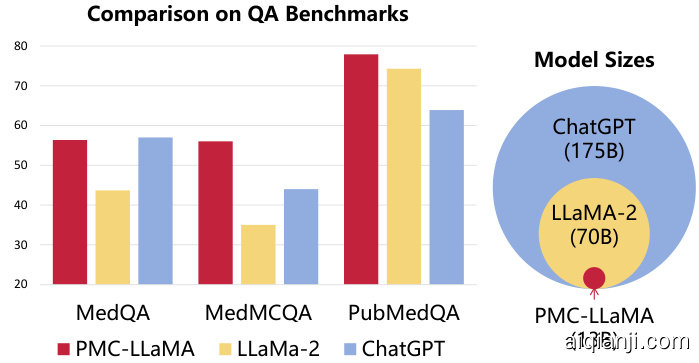
Figure 1: In the left, we show the general comparison between our PMC-LLaMA with LLaMA-2 and ChatGPT. On the right, we visually show the advantages of our model in model sizes. PMC-LLaMA is much smaller than the others.
图 1: 左侧展示了我们的PMC-LLaMA与LLaMA-2及ChatGPT的总体对比。右侧直观呈现了我们的模型在参数量级上的优势。PMC-LLaMA明显小于其他模型。
Existing works have also explored several ways for adapting general-purpose LLMs towards medicine domain, like Med-Alpaca (Han, Adams et al. 2023), Chat-Doctor (Yunxiang et al. 2023) and MedPALM-2 (Anil, Dai et al. 2023). Among these, MedPALM-2 is the only work successfully outperforming ChatGPT while their training details, for example, training data, model architecture, remain unclear. Thus, systematic investigation on the medical domain adaptation for LLMs still needs to be discussed further especially in open-source community.
现有研究也探索了多种将通用大语言模型适配到医疗领域的方法,例如Med-Alpaca (Han, Adams et al. 2023)、Chat-Doctor (Yunxiang et al. 2023)和MedPALM-2 (Anil, Dai et al. 2023)。其中,MedPALM-2是唯一成功超越ChatGPT的工作,但其训练细节(如训练数据、模型架构)仍不明确。因此,针对大语言模型的医疗领域适配仍需系统性研究,特别是在开源社区中亟待深入探讨。
Our goal is to systematically adapt an open-source general LLM, i.e., LLaMA, towards the medicine domain from the following aspects. First, we adopt data-centric medicalspecific knowledge injection for the language model with a large-scale free text medical corpora. We claim that language models can accumulate enough medical knowledge in this step and build up a better embedding space for domainspecific complex terminologies. Second, augmenting the reasoning capabilities of the proposed model. This empowers the model to link its medical knowledge with provied case information and provide well-justified recommendations. Lastly, enhancing the alignment ability of LLMs. Robust alignment with various instructions facilitates effective zero-shot adaptation to a diverse spectrum of tasks.
我们的目标是从以下几个方面系统性地将开源通用大语言模型(即LLaMA)适配至医疗领域。首先,我们采用以数据为中心的医学专业知识注入方法,通过大规模自由文本医学语料库增强语言模型。我们认为语言模型在此阶段能积累足够的医学知识,并为领域内复杂术语构建更优质的嵌入空间。其次,增强所提模型的推理能力。这使模型能够将其医学知识与提供的病例信息相关联,并给出合理建议。最后,提升大语言模型的对齐能力。与多样化指令的稳健对齐有助于实现针对广泛任务的零样本高效适配。
In conclusion, in this paper we systematically build up an LLM for medicine through data-centric knowledge injection and medical-specific instruction tuning, and release an open-source lightweight medical-specific language model, PMC-LLaMA. Specifically, we first collect a large medical-specific corpus, named MedC-K, consisting of 4.8M biomedical academic papers and 30K textbooks for knowledge injection. We then adopt medical-specific instruction tuning on a new medical knowledge-aware instruction dataset, termed MedC-I, consisting of medical QA, ra- tionale, and conversation with 202M tokens in total. We evaluate PMC-LLaMA on various medical QA benchmarks, surpassing ChatGPT and LLaMA-2 as shown in Fig. 1.
总之,本文通过以数据为中心的知识注入和医学专用指令微调,系统性地构建了一个医学大语言模型,并开源了轻量级医学专用语言模型PMC-LLaMA。具体而言,我们首先收集了名为MedC-K的大型医学专用语料库,包含480万篇生物医学学术论文和3万本教科书用于知识注入。随后基于新型医学知识感知指令数据集MedC-I(包含医学问答、原理阐述及对话,总计2.02亿token)进行医学专用指令微调。如图1所示,PMC-LLaMA在多项医学问答基准测试中表现优于ChatGPT和LLaMA-2。
Related Work
相关工作
Large Language Model. Recently, the great success of large language models (LLM) (OpenAI 2023b,a; Anil, Dai et al. 2023; Du et al. 2021), has garnered significant attention within the field of natural language processing. For example, OpenAI’s strides with ChatGPT and GPT-4 have showcased remarkable capabilities in various tasks, including text generation, language translation, question answering, and more. However, intricate details concerning their training methodologies and weight parameters remain undisclosed. LLaMA (Touvron et al. 2023a) serves as an open-source alternative for the foundational language model, ranging from 7 billion to 65 billion parameters. In light of these advancements, there has been a surge of interest in tailoring language models for specific biomedical domains. Most of these models are prompt-tuned using LLaMA on a small medical corpus, resulting in a deficiency of comprehensive medical knowledge integration.
大语言模型 (Large Language Model)。近期,大语言模型 (LLM) (OpenAI 2023b,a; Anil, Dai et al. 2023; Du et al. 2021) 的巨大成功在自然语言处理领域引起了广泛关注。例如,OpenAI 推出的 ChatGPT 和 GPT-4 在文本生成、语言翻译、问答等多种任务中展现了卓越能力。然而,其训练方法和权重参数等核心细节仍未公开。LLaMA (Touvron et al. 2023a) 作为开源基础语言模型,提供了参数量从 70 亿到 650 亿不等的替代方案。随着这些技术进步,针对生物医学领域定制语言模型的研究兴趣激增。当前多数模型基于 LLaMA 在小规模医学语料上进行提示微调 (prompt-tuning),导致医学知识整合不够全面。
Instruction Tuning. For LLMs to follow natural language instructions and complete real-world tasks, instructiontuning has been widely used for alignment (Ouyang et al. 2022; Peng et al. 2023). This involves fine-tuning the model on a collection of tasks described via instructions, to effectively improve the zero-shot and few-shot generalization abilities of LLMs (Chung et al. 2022; Iyer et al. 2022). Building on the publicly accessible language models, Alpace (Taori et al. 2023) and Vicuna (Chiang, Li, and others. 2023) are proposed, by finetuning on the machine-generated instruction-following samples, showing promising performance. In the medical domain, Chat-Doctor (Yunxiang et al. 2023), and Med-Alpaca (Han, Adams et al. 2023), are instruction-tuned for medical question-answering and dialogue applications. Notably, Med-PaLM (Singhal et al. 2022) represents the pinnacle of LLMs in the medical field, trained with intensive instruction tuning on the strong PaLM model (with 540 billion parameters). However, its code and data remain inaccessible to the public.
指令微调 (Instruction Tuning)。为使大语言模型能遵循自然语言指令并完成现实任务,指令微调被广泛用于对齐 (Ouyang et al. 2022; Peng et al. 2023)。该方法通过在指令描述的任务集合上微调模型,有效提升大语言模型的零样本和少样本泛化能力 (Chung et al. 2022; Iyer et al. 2022)。基于公开可用的语言模型,Alpace (Taori et al. 2023) 和 Vicuna (Chiang, Li, and others. 2023) 通过对机器生成的指令跟随样本进行微调而提出,展现出优异性能。在医疗领域,Chat-Doctor (Yunxiang et al. 2023) 和 Med-Alpaca (Han, Adams et al. 2023) 针对医疗问答和对话应用进行了指令微调。值得注意的是,Med-PaLM (Singhal et al. 2022) 代表了医疗领域大语言模型的巅峰,其基于强大的 PaLM 模型 (5400亿参数) 进行了密集的指令微调训练,但其代码和数据仍未向公众开放。
Medical Foundational Language Model. In addition to instruction tuning, there has been extensive efforts on training foundation model for medicine, for example, BioBert, BioMedGPT, etc. (Lee et al. 2020; Zhang et al. 2023; Luo et al. 2022). However, these models exhibit certain limitations, first, most domain-specific models have been exclusively trained on medical corpora. The lack of exposure to diverse knowledge domains beyond medicine can impede the model’s capability to perform reasoning or context understanding; second, these models are limited in model scale and are predominantly designed to base on BERT, thus imposing restrictions on their utility for a wide array of downstream tasks under zero-shot learning. In this work, we aim to resolve these two limitations by adapting a general LLM toward medicine with knowledge injection, followed by medical-specific instruction tuning.
医疗基础语言模型。除了指令微调外,医学领域的基础模型训练也取得了广泛进展,例如 BioBert、BioMedGPT 等 (Lee et al. 2020; Zhang et al. 2023; Luo et al. 2022)。然而,这些模型存在一定局限性:首先,大多数领域专用模型仅针对医学语料库进行训练,缺乏医学之外多样化知识领域的接触,可能阻碍模型执行推理或上下文理解的能力;其次,这些模型的规模有限,且主要基于 BERT 架构设计,因此在零样本学习下对广泛下游任务的实用性受到限制。本研究旨在通过向通用大语言模型注入医学知识并进行医学专用指令微调,从而解决这两项局限性。
Problem Formulation
问题描述
In this paper, our goal is to systematically investigate the procedure for steering a pre-trained foundational language model to the knowledge-intense domain, i.e., medicine. The training process can be divided into two stages: first, a datacentric knowledge injection stage, that aims to enrich the language model with fundamental medical knowledge; second, a medical-specific instruction tuning stage, that tailors the model to align with clinical use cases.
本文旨在系统研究如何将预训练的基础大语言模型引导至知识密集型领域(如医学)。训练过程分为两个阶段:首先是以数据为中心的知识注入阶段,旨在用基础医学知识丰富语言模型;其次是医学专用指令微调阶段,使模型适配临床用例。
At training stage, assuming the text input as a sequence of tokens, e.g., $\bar{\mathcal{U}}={u_ {1},\bar{u_ {2}},\bar{. }..,u_ {N}}$ , where each $u_ {i}$ is a text token and $N$ is the total sequence length, the training objective is to minimize auto-regressive loss, with the major difference on whether to compute loss on the entire sequence or only sub-sequence, as detailed in the following.
在训练阶段,假设文本输入为一个token序列,例如 $\bar{\mathcal{U}}={u_ {1},\bar{u_ {2}},\bar{. }..,u_ {N}}$ ,其中每个 $u_ {i}$ 是一个文本token, $N$ 是序列总长度。训练目标是最小化自回归损失,主要区别在于计算损失时是针对整个序列还是子序列,具体如下所述。
Data-centric Knowledge Injection. For the knowledge injection step, we simply minimize the default autoregressive loss, all free-form texts on medical knowledge can be used, for the model to accumulate sufficient medicalspecific knowledge contexts, formulated as
以数据为中心的知识注入。在知识注入步骤中,我们仅最小化默认的自回归损失,所有关于医学知识的自由文本均可用于让模型积累足够的医学特定知识上下文,其公式表达为
$$
L(\Phi)=-\sum\log\Phi(u_ {i}|u_ {<i}).
$$
$$
L(\Phi)=-\sum\log\Phi(u_ {i}|u_ {<i}).
$$
where $u_ {<i}$ indicates the tokens appear before index $i$ and $\Phi$ denotes our model.
其中 $u_ {<i}$ 表示索引 $i$ 之前出现的 token,$\Phi$ 代表我们的模型。
Medical-specific Instruction Tuning. At this stage, the token sequence is further split into instruction $\mathcal{T}$ , and response $\mathcal{R}$ , the former is to mimic user’s query, thus the loss is ignored at training time, denoted as:
医疗专用指令微调。在此阶段,token序列被进一步拆分为指令$\mathcal{T}$和响应$\mathcal{R}$,前者用于模拟用户查询,因此在训练时忽略其损失,表示为:
$$
L(\Phi)=-\sum_ {u_ {i}\in\mathcal{R}}\log\Phi(u_ {i}|u_ {<i},\mathcal{T}).
$$
$$
L(\Phi)=-\sum_ {u_ {i}\in\mathcal{R}}\log\Phi(u_ {i}|u_ {<i},\mathcal{T}).
$$
At inference time, the common use case is a conversation, where the user normally provides the question as instruction $\mathcal{T}$ , and the output of the model serves as the answer.
在推理阶段,常见的使用场景是对话交互,用户通常以指令$\mathcal{T}$形式提出问题,模型输出则作为回答。
Dataset Construction
数据集构建
To support our two-stage training, namely data-centric knowledge injection, and medical-specific instruction tuning for alignment, we herein detail the procedure for constructing the high-quality language datasets.
为支持我们的两阶段训练(即数据为中心的知识注入和医疗专用指令微调以实现对齐),本文详细介绍了构建高质量语言数据集的流程。
Dataset-I: Fundamental Medical Knowledge
Dataset-I: 基础医学知识
To steer a general-purpose foundational language model for medical scenario, we propose to first conduct data-centric knowledge injection, that aims to expose the model with medical-related terminologies and definitions. We primarily focus on two key data sources, namely, biomedical papers and textbooks.
为了引导通用基础语言模型适应医疗场景,我们提出首先进行以数据为中心的知识注入,旨在让模型接触医学术语和定义。我们主要关注两个关键数据源:生物医学论文和教科书。
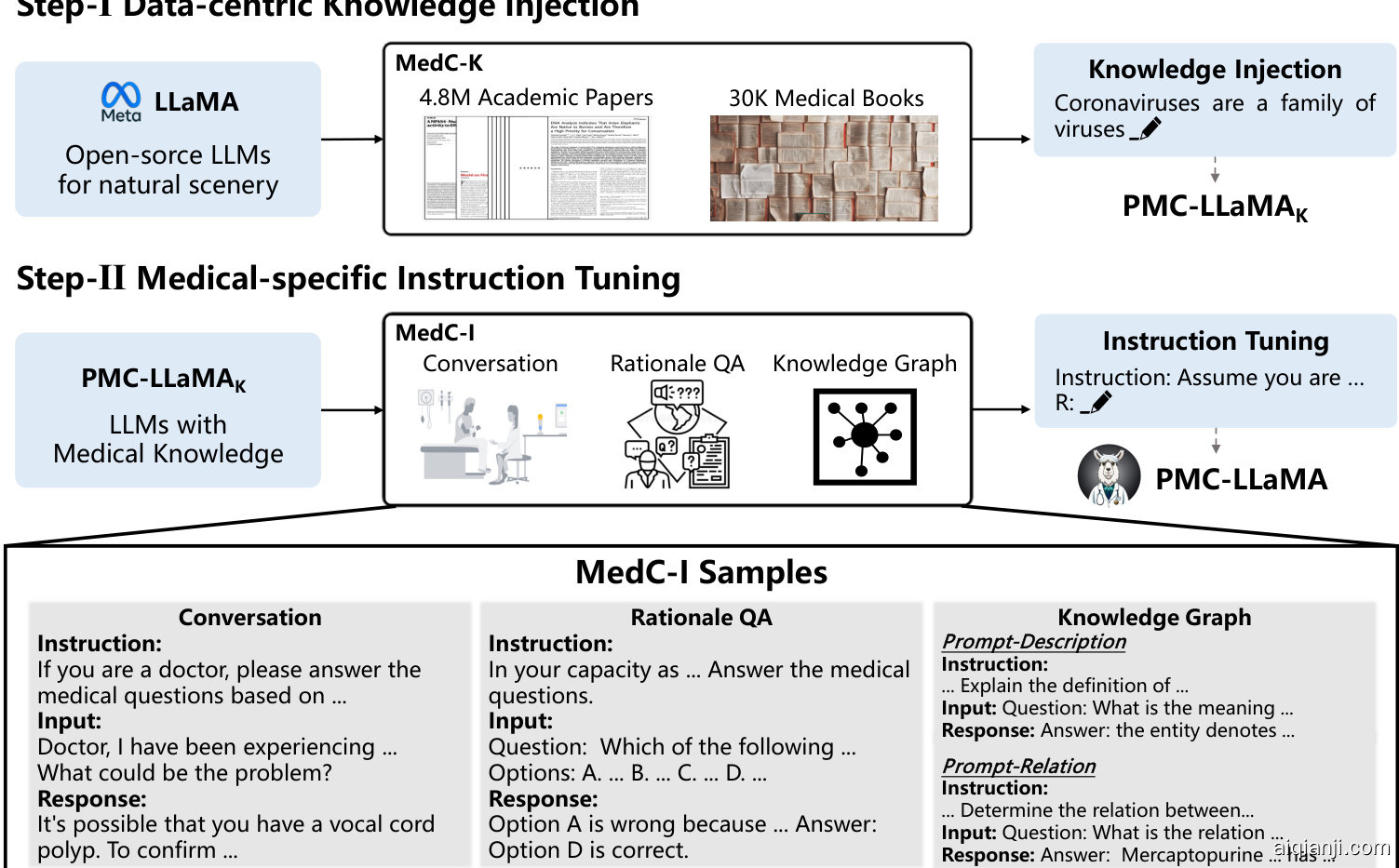
Figure 2: The training pipeline of PMC-LLaMA. Our training flow can be separated into two parts, i.e., data-centric knowledge injection and medical-specific instruction tuning. In knowledge injection, we collect 4.8M biomedical academic papers and 30K medical books for further injecting knowledge into LLaMA. In the instruction tuning stage, we mainly consider three aspects, medical conversation, medical rationale question-answering, and knowledge graph, containing 202M tokens in total.
图 2: PMC-LLaMA 的训练流程。我们的训练流程可分为两部分:以数据为中心的知识注入和医疗专用指令微调。在知识注入阶段,我们收集了480万篇生物医学学术论文和3万本医学书籍,用于向LLaMA进一步注入知识。在指令微调阶段,我们主要考虑三个方面:医疗对话、医学原理问答和知识图谱,总计包含2.02亿个token。
Papers. As a valuable knowledge resource, academic papers naturally contains high-quality, cutting-edge medical knowledge. We start with the S2ORC (Lo et al. 2020) Datasets with 81.1M English-language academic papers, and pick out those biomedical related papers depending on whether having corresponding PubMed Central (PMC) IDs. As a result, there are around 4.8M biomedical papers left, totaling over 75B tokens.
论文。作为宝贵的知识资源,学术论文天然包含高质量、前沿的医学知识。我们从包含8110万篇英文论文的S2ORC数据集 (Lo et al. 2020) 出发,根据是否具有PubMed Central (PMC) ID筛选出生物医学相关论文。最终保留约480万篇生物医学论文,总计超过750亿token。
Books. We collect 30K textbooks sourced from various outlets, for example, the open-library, university library, and reputable publishers, covering a wide range of medical specialties as shown in Fig. 3. For preprocessing, we first extract the text content from the book PDF, then carry out data cleaning via de-duplication and content filtering. Specifically, we eliminate extraneous elements such as URLs, author lists, superfluous information, document contents, references, and citations. Additionally, we have also removed any references to images and tables within the paragraphs, for example, ‘Fig. 1’. After this thorough cleaning process, there are approximately 4B tokens left.
图书。我们收集了来自开放图书馆、大学图书馆和知名出版商等不同渠道的3万本教科书,涵盖广泛的医学专业领域,如图3所示。在预处理阶段,我们首先从图书PDF中提取文本内容,随后通过去重和内容过滤进行数据清洗。具体而言,我们移除了URL、作者列表、冗余信息、文档目录、参考文献和引用等无关内容,并删除了段落中对图表的所有引用(例如"图1")。经过彻底清洗后,剩余约40亿token。
Combination. The two corpora encompass distinct types of medical knowledge, while papers predominantly capture cutting-edge insights, books capture more fundamental medical knowledge, which is more crucial for pre-trained general-purpose language models. Hence, when blending these two datasets for knowledge injection training, we use a ratio of 15:4:1 at each training batch, by that we mean to emphasize “book” tokens more. Specifically, we sample more tokens from books, ensuring they occupy 15 parts per batch and sample tokens from “papers” less so that they occupy 4 parts per batch. For the remaining 1 occupation, we sample from a general language corpus, RedPajama-Data (Computer 2023) to form a complete batch. This mainly aims to avert catastrophic forgetting of previously acquired general text knowledge after extensive knowledge injection on largescale medical-specific data.
组合。这两个语料库涵盖不同类型的医学知识,其中论文主要捕捉前沿见解,而书籍则包含更基础的医学知识,这对预训练的通用语言模型更为关键。因此,在混合这两个数据集进行知识注入训练时,我们在每个训练批次采用15:4:1的比例,即更强调"书籍"token。具体而言,我们从书籍中采样更多token,确保它们每批次占15份,同时减少从"论文"中采样的token,使其每批次占4份。剩余的1份则从通用语言语料库RedPajama-Data (Computer 2023)中采样,以构成完整批次。这主要是为了避免在大规模医学专用数据上进行广泛知识注入后,出现对先前掌握的通用文本知识的灾难性遗忘。
Knowledge Injection Training. Till here, we have constructed a large-scale language dataset of fundamental medical knowledge, termed as MedC-K. With such corpus, we conduct data-centric knowledge injection with autoregressive training, resulting a language model for medicine, named as PMC-LLaMAK, as the largest number of tokens are from PubMed Central academic papers.
知识注入训练。至此,我们已构建了一个基础医学知识的大规模语言数据集,称为MedC-K。基于该语料库,我们采用自回归训练进行以数据为中心的知识注入,最终生成一个医学领域的大语言模型,命名为PMC-LLaMAK(因其绝大部分token源自PubMed Central学术论文)。
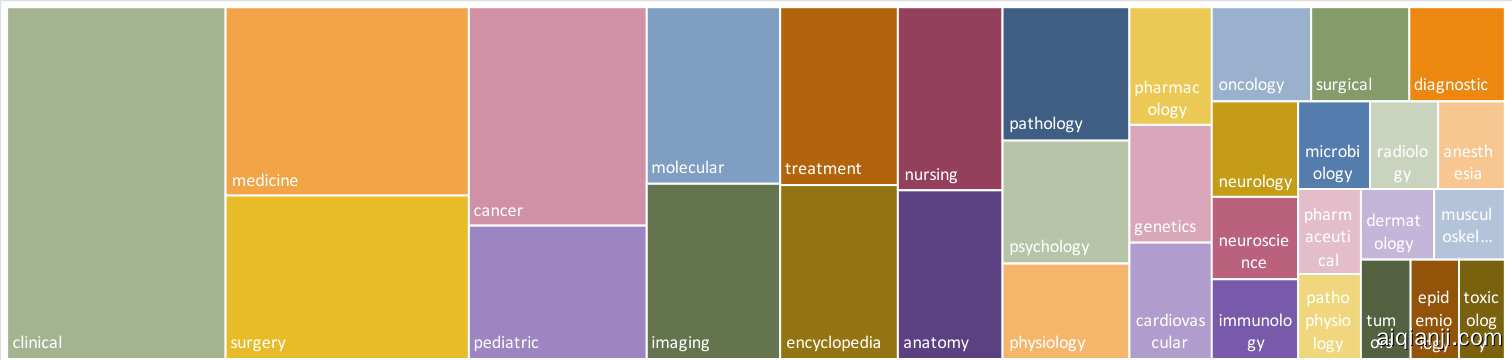
Figure 3: Distribution of medical textbooks categories. The box sizes denote the book numbers for different categories.
图 3: 医学教材类别分布。箱体大小表示不同类别的书籍数量。
Dataset-II: Medical Instructions
Dataset-II: 医学指令
Here, we proceed to carry out instruction tuning with the goal of guiding the model to respond to various instructions, by exploiting the medical knowledge embedded in PMC $\mathrm{LLaMA_ {K}}$ model. Generally speaking, our instruction tuning datasets are composed of three main parts, namely, medical consulting conversation, medical rationale QA, and medical knowledge graph prompting.
我们在此进行指令微调,旨在通过利用PMC $\mathrm{LLaMA_ {K}}$ 模型中嵌入的医学知识,引导模型响应各类指令。总体而言,我们的指令微调数据集由三大部分组成:医疗咨询对话、医学原理问答以及医学知识图谱提示。
Medical Conversation. Considering there exists diverse doctor-patient dialogues in daily life, the questions raised by patients are naturally suitable as instructions and doctor responses as ground truth. We start with the data collected by Med-Alpaca (Han, Adams et al. 2023) and ChatDoctor (Yunxiang et al. 2023), and further expand the provided instructions into various synonymous sentences to improve model’s robustness to diverse instructions. Specifically, we use the GPT-4 with the following query prompt:
医疗对话。考虑到日常生活中存在多样化的医患对话,患者提出的问题自然适合作为指令,而医生的回答则作为真实答案。我们从 Med-Alpaca (Han, Adams et al. 2023) 和 ChatDoctor (Yunxiang et al. 2023) 收集的数据入手,进一步将提供的指令扩展为各种同义句,以提高模型对不同指令的鲁棒性。具体而言,我们使用 GPT-4 并输入以下查询提示:
“Rewrite 10 sentences that convey similar meanings to what I’ve stated: {instruction seeds}.”,
重写10个表达与我所述含义相似的句子: {指令种子}。
where {instruction seeds} denotes the provided instruction from ChatDoctor or MedAlpaca, and the query can be repeated until the desired prompt number. At training time, we randomly select one instruction from the instruction base, to simulate the inputs from real users and avoid over-fitting on specific instruction templates.
其中 {instruction seeds} 表示来自 ChatDoctor 或 MedAlpaca 提供的指令,查询可重复执行直至达到所需提示数量。训练时,我们会随机从指令库中选择一条指令,以模拟真实用户输入并避免对特定指令模板过拟合。
Medical Rationale QA. Beyond daily conversations, we also consider equipping our model with reasoning ability with professional medical knowledge. We start with the training sets of the open-source medical multi-choice question-answering datasets, such as USMLE (Jin, Pan et al. 2021), PubMedQA (Jin et al. 2019) and MedMCQA (Pal, Umapathi et al. 2022). Despite the questions in them naturally demanding medical-specific knowledge, most of these datasets only include plain choices, lacking detailed reasoning guidance. To complement such information, we prompt ChatGPT (OpenAI 2023b) for causality analysis. Specifically, given a QA pair, we query ChatGPT to get rationale output (check supplementary for details), and treat the output as an explanation with structured format shown at the bottom of Fig. 2.
医学原理问答。除了日常对话外,我们还考虑为模型配备专业医学知识的推理能力。我们从开源医学多选题数据集的训练集开始,例如USMLE (Jin, Pan et al. 2021)、PubMedQA (Jin et al. 2019)和MedMCQA (Pal, Umapathi et al. 2022)。尽管这些问题天然需要医学专业知识,但大多数数据集仅包含简单选项,缺乏详细的推理指导。为补充此类信息,我们使用ChatGPT (OpenAI 2023b)进行因果分析。具体而言,给定一个问答对,我们查询ChatGPT以获取原理输出(详见补充材料),并将该输出视为结构化格式的解释,如图2底部所示。
Medical Knowledge Graph Prompting. In addition to the aforementioned data, we also consider exploiting medical knowledge graphs UMLS (Lindberg, Humphreys, and McCray 1993), to align with clinicians’ experience. Specifically, to link the medical terminologies with their respective knowledge description or corresponding relationships, we construct QA pairs to translate the common knowledge graph. There are two main types contained in medical knowledge graph, i.e., entity descriptions and entity relationships. We add two different prompts for them as shown at the bottom of Fig. 2, that demands the model to output descriptions for a certain entity or predict the relationship between two entities.
医学知识图谱提示。除上述数据外,我们还考虑利用医学知识图谱UMLS (Lindberg, Humphreys, and McCray 1993) 来与临床医生的经验对齐。具体而言,为将医学术语与其知识描述或对应关系建立关联,我们构建了问答对来转化通用知识图谱。医学知识图谱主要包含两种类型,即实体描述和实体关系。如图2底部所示,我们为它们添加了两种不同的提示,要求模型输出特定实体的描述或预测两个实体间的关系。
Medical-spcific Instruction Tuning. By combining the above three parts together, we form a large-scale, highquality, medical-specific instruction tuning dataset, MedCI, consisting 202M tokens. We further tune PMC-LLaMA $\mathrm{K}$ on it, resulting in our final model – PMC-LLaMA.
医疗领域专用指令微调。通过整合上述三部分内容,我们构建了一个大规模、高质量的医疗领域专用指令微调数据集MedCI,包含2.02亿token。我们在此基础上对PMC-LLaMA $\mathrm{K}$ 进行微调,最终得到我们的目标模型——PMC-LLaMA。
Experiment
实验
Training Details
训练细节
We start by carrying out knowledge injection on open-source LLaMA model, optimizing an auto-regressive loss. Specifically, at training time, the max context length is set as 2048, with a batch size to be 3200, and the model is trained with AdamW optimizer (Loshchilov and Hutter 2017) with a learning rate 2e-5. We adopt the Fully Sharded Data Parallel (FSDP) acceleration strategy, bf16 (Brain Floating Point) data format, and gradient check pointing (Chen et al. 2016). Since we sample more tokens from books in each batch, the model will finish seeing all book tokens earlier. Thus, we here define 1 epoch for seeing all book tokens instead of seeing all mixed tokens. The model is trained with knowledge injection for 5 epochs with 32 A100 GPUs. Then we carry out medical-specific instruction tuning on MedC-I, for 3 epochs with 256 batch sizewith 8 A100 GPUs. Note that, at instruction tuning stage, each epoch refers to looping through all sequences.
我们首先在开源LLaMA模型上进行知识注入,优化自回归损失。具体而言,训练时设置最大上下文长度为2048,批次大小为3200,采用AdamW优化器(Loshchilov and Hutter 2017)进行训练,学习率为2e-5。我们采用全分片数据并行(FSDP)加速策略、bf16(脑浮点)数据格式和梯度检查点(Chen et al. 2016)。由于每个批次从书籍中采样更多token,模型会更早遍历完所有书籍token。因此,我们定义1个epoch为遍历全部书籍token而非混合token。模型使用32块A100 GPU进行5个epoch的知识注入训练。随后在MedC-I数据集上进行医疗专用指令微调,使用8块A100 GPU以256批次大小训练3个epoch。需注意,在指令微调阶段,每个epoch指遍历所有数据序列一次。
Benchmarks
基准测试
In the literature, the primary method for measuring the ability of medical language models is based on multiple-choice question answering, which uses accuracy as the main metric. Following the convention, we adopt three prominent medical question-answering (QA) benchmarks for evaluation.
在文献中,衡量医学语言模型能力的主要方法是基于选择题回答,以准确率作为核心指标。按照惯例,我们采用三个权威的医学问答基准进行评估。
• PubMedQA (Jin et al. 2019) is a biomedical QA dataset collected from PubMed abstracts. The task of PubMedQA is to answer research questions with yes/no/- maybe, which can be considered as the multiple-choice question. It is split into three subsets: 1k manually labeled pairs (PQA-L), $61.2\mathrm{k}$ unlabeled pairs (PQA-U), and 211.3k artificially generated pairs (PQA-A). Following former works (Diao, Pan et al. 2023), we view PQAA as the train set, PQA-L as the test set, and discard the PQA-U parts.
• PubMedQA (Jin et al. 2019) 是一个从PubMed摘要中收集的生物医学问答数据集。该任务要求用"是/否/可能"回答研究问题,可视为多选题。数据集分为三个子集:1k人工标注样本(PQA-L)、$61.2\mathrm{k}$未标注样本(PQA-U)和211.3k人工生成样本(PQA-A)。遵循先前研究(Diao, Pan et al. 2023),我们将PQA-A作为训练集,PQA-L作为测试集,并舍弃PQA-U部分。
• MedMCQA (Pal, Umapathi et al. 2022) is a dataset of multiple choice questions, that are sourced from mock exams and past exams of two Indian medical school entrance exams called AIIMS and NEET-PG (Pal, Umapathi et al. 2022). The train split contains 182,822 questions, and the test split contains 4183 questions. Each question has 4 choices.
• MedMCQA (Pal, Umapathi等, 2022) 是一个多选题数据集,题目来源于印度两所医学院入学考试AIIMS和NEET-PG的模拟试题与历年真题 (Pal, Umapathi等, 2022)。训练集包含182,822道题目,测试集包含4,183道题目。每道题设有4个选项。
• USMLE (Jin, Pan et al. 2021) is a dataset of multiple choice questions (4 choices per question), based on the United States Medical License Exams. The dataset is collected from the professional medical board exams, covering three languages: English, simplified Chinese, and traditional Chinese, containing 12,724, 34,251, and 14,123 questions respectively. Here, we use the English parts and split it into 10,178 questions for training, 1273 for validation, and 1273 for testing, following the official splits.
• USMLE (Jin, Pan et al. 2021) 是一个基于美国医学执照考试的选择题数据集 (每道题4个选项)。该数据集采集自专业医学委员会考试,涵盖英语、简体中文和繁体中文三种语言,分别包含12,724、34,251和14,123道题目。本文采用官方划分的英语部分数据,其中10,178道题用于训练,1,273道用于验证,1,273道用于测试。
Baseline Models
基线模型
LLaMA (Touvron et al. 2023a). LLaMA is the most widely-used open-source language model, it has been trained on a large text corpus with only auto-regressive learning, i.e., no instruction tuning is involved.
LLaMA (Touvron et al. 2023a)。LLaMA是使用最广泛的开源大语言模型,它仅通过自回归学习在大型文本语料库上进行训练,即未涉及指令微调。
LLaMA-2 (Touvron et al. 2023b). LLaMA-2 is the improved version of LLaMA that has been further tuned with instructions. Its largest version (70B) is reported to be the best on natural scenery among the open-source LLMs.
LLaMA-2 (Touvron et al. 2023b)。LLaMA-2是LLaMA的改进版本,经过指令进一步调优。其最大版本(70B)被报告为开源大语言模型中自然场景表现最佳者。
ChatGPT (OpenAI 2023b). ChatGPT is a commercial model released by OpenAI in November, 2022, that has shown remarkable performance on a wide range of NLP tasks in various domains, including medicine. Note that, since the exact details of ChatGPT are confidential, we follow the general presumption that ChatGPT is roughly the same as GPT-3 in model sizes (175B) (Kung et al. 2022).
ChatGPT (OpenAI 2023b)。ChatGPT 是 OpenAI 于 2022 年 11 月发布的商用模型,在包括医学在内的多个领域 NLP 任务中展现出卓越性能。需注意的是,由于 ChatGPT 的具体细节属于机密信息,我们遵循普遍假设,即其模型规模 (175B) 与 GPT-3 大致相当 (Kung et al. 2022)。
Med-Alpaca (Han, Adams et al. 2023). Med-Alpaca is a model further fine-tuned on Alpaca (Taori et al. 2023) using medical instruction data. They focus on the task of assisting medical dialogues and question-answering.
Med-Alpaca (Han, Adams et al. 2023)。Med-Alpaca是基于Alpaca (Taori et al. 2023) 使用医学指令数据进一步微调的模型,其核心目标是辅助医学对话和问答任务。
Chat-Doctor (Yunxiang et al. 2023). Chat-Doctor is a language model aiming for health assistants, that is designed to provide users with medical information, advice, and guidance. For training, it has leveraged the dialogue-based instruction tuning data.
Chat-Doctor (Yunxiang et al. 2023)。Chat-Doctor是一款面向健康助手的语言模型,旨在为用户提供医疗信息、建议和指导。其训练采用了基于对话的指令微调数据。
Evaluation Settings
评估设置
In this section, we describe the evaluating detail to compare the above language models on the QA benchmarks.
在本节中,我们将详细描述如何在问答基准测试上比较上述语言模型的评估细节。
Note that, we do not claim the presented comparison to be completely fair, as a number of training details, for example, data, architecture remain undisclosed for the commercial model. Therefore, we only treat these baseline models for reference, and more focused on presenting our procedure for building on a powerful language model for medicine.
需要注意的是,我们并不声称所呈现的比较完全公平,因为商业模型的许多训练细节(例如数据、架构)仍未公开。因此,我们仅将这些基线模型作为参考,更侧重于展示我们基于强大医学语言模型的构建流程。
Our evaluation settings can be divided into two types: task-specific fine-tuning evaluation and zero-shot instruction evaluation.
我们的评估设置可分为两种类型:任务特定微调评估和零样本指令评估。
Task-specific Fine-tuning Evaluation. In this evaluation setting, we use the combination of three QA training sets to further fine-tune a language model and then evaluate it. For models without instruction tuning, for example, LLaMA and PMC-LLaMAK, we adopt this evaluation setting by default.
任务特定微调评估。在此评估设置中,我们使用三个问答训练集的组合进一步微调语言模型并进行评估。对于未经指令微调的模型(例如LLaMA和PMC-LLaMAK),默认采用此评估设置。
Zero-shot Instruction Evaluation. In this evaluation setting, we directly test the model by giving a medical QA instruction, e.g., “Make a choice based on the question and options.”, without doing any task-specific fine-tuning. Most models are evaluated in this setting, i.e., LLaMA-2, MedAlpaca, Chat-Doctor, ChatGPT, and our own PMC-LLaMA.
零样本指令评估。在此评估设置中,我们直接通过给出医疗问答指令(例如"根据问题和选项做出选择")来测试模型,无需进行任何任务特定的微调。大多数模型在此设置下进行评估,包括 LLaMA-2、MedAlpaca、Chat-Doctor、ChatGPT 以及我们自己的 PMC-LLaMA。
Results
结果
In this section, we will introduce the experimental results. First, we conduct thorough ablation study on medical QA benchmarks, to demonstrate the effectiveness of the different components in our training procedure. Then we show the comparison with different SOTA methods. Lastly, we present qualitative cases studies.
在本节中,我们将介绍实验结果。首先,我们在医疗问答基准上进行了全面的消融研究,以证明训练流程中不同组件的有效性。接着展示了与不同SOTA (state-of-the-art) 方法的对比结果。最后呈现了定性案例分析。
Ablation Study
消融实验
As shown in Tab. 1, we systematically study the different design choices on various medical QA benchmarks, for example, effect of the model scale, data-centric knowledge injection, and medical-specific instruction tuning.
如表 1 所示,我们系统地研究了不同设计选择在各种医疗问答基准上的表现,例如模型规模的影响、以数据为中心的知识注入以及针对医疗领域的指令微调。
Model scale. The scaling law (Kaplan et al. 2020) can also be observed in the medical corpus, for example, as shown in the table, when switching the model size from 7B to 13B, performance on all benchmarks have been improved. This phenomenon holds for both baseline LLaMA model and PMC-LLa $\mathbf{MA}_ {\mathrm{K}}$ , which has further trained with fundamental medical knowledge.
模型规模。缩放定律 (Kaplan et al. 2020) 在医学语料库中同样适用,例如表中所示,当模型规模从 7B 提升至 13B 时,所有基准测试性能均得到提升。这一现象在基线 LLaMA 模型和经过基础医学知识进一步训练的 PMC-LLa $\mathbf{MA}_ {\mathrm{K}}$ 上均成立。
Data-centric knowledge injection. Compared with baseline 7B LLaMA model, integrating biomedical papers brings a performance gain from $44.54%$ to $44.70%$ and $48.51%$ to $50.54%$ on MedQA and MedMCQA respectively. While af-ter adding books for training, the performance is improved significantly, i.e., obtaining $1.02%$ , $2.94%$ , and $1.\bar{2}%$ on MedQA, MedMCQA and PubMedQA respectively. Both observations have shown the importance of injecting fundamental medical knowledge.
以数据为中心的知识注入。相比基线7B LLaMA模型,整合生物医学论文使MedQA和MedMCQA上的性能分别从$44.54%$提升至$44.70%$、$48.51%$提升至$50.54%$。而加入书籍训练后性能显著提升,在MedQA、MedMCQA和PubMedQA上分别获得$1.02%$、$2.94%$和$1.\bar{2}%$的改进。两项观察均证明了注入基础医学知识的重要性。
Medical-specific instruction tuning. We start instruction tuning with only rationale QA data. In this cases, since only QA task is considered, the difference from task-specific finetuning only lies on whether to give rationale sentence as supervision signal. We observe that simply incorporating rationale cases can lead to enhance QA results compared to task-specific fine-tuning on plain choice data, showcasing an improvement of $1.17%$ on the MedQA dataset.
医学专用指令调优。我们仅从原理问答(QA)数据开始指令调优。在这种情况下,由于只考虑QA任务,与任务特定微调的区别仅在于是否提供原理句作为监督信号。我们观察到,相较于仅使用选择题数据的任务特定微调,简单引入原理案例就能提升QA结果,在MedQA数据集上显示出1.17%的改进。
Table 1: Ablation study on QA benchmarks. ACC scores are reported in the table. Note that for the models without ability to follow instruction, we task-specific fine-tune them on the combination of the three downstream training sets to get the number.
| Method | ModelSize | Knowledge Injection | Instruction Tuning e Conversation Knowledge Graph | MedQAMedMCQAPubMedQA | |||||
| Papers | Books | Rationale | |||||||
| Baseline (LLaMA) Baseline (LLaMA) | 7B | × × | × | × × | × × | × | 44.54 45.48 | 48.51 51.42 | 73.40 76.40 |
| PMC-LLaMAK | 13B | ||||||||
| 7B | √ √ | √ | × × | × × | 44.70 | 50.54 | 69.50 | ||
| 7B 13B | √ | √ | × | × | × | 45.56 48.15 | 51.45 54.15 | 74.60 77.10 | |
| PMC-LLaMA | √ | √ | √ | × | |||||
| 13B 13B | √ | √ | √ | √ | × | 49.32 54.43 | 54.56 55.77 | 77.20 77.00 | |
| 13B | √ | √ | √ | √ | √ | 56.36 | 56.04 | 77.90 | |
表 1: QA基准消融研究。表中报告的是ACC分数。请注意,对于不具备指令跟随能力的模型,我们在三个下游训练集的组合上对它们进行了特定任务的微调以获取数据。
| 方法 | 模型大小 | 知识注入 | 指令调优与对话知识图谱 | MedQA | MedMCQA | PubMedQA |
|---|---|---|---|---|---|---|
| 论文 | 书籍 | 原理 | ||||
| Baseline (LLaMA) | 7B | × | × | × | × | × |
| Baseline (LLaMA) | 7B | × | × | × | × | × |
| PMC-LLaMAK | 13B | |||||
| PMC-LLaMAK | 7B | √ | √ | × | × | |
| PMC-LLaMAK | 7B | √ | √ | × | × | × |
| PMC-LLaMAK | 13B | √ | √ | × | × | × |
| PMC-LLaMA | 13B | √ | √ | √ | × | |
| PMC-LLaMA | 13B | √ | √ | √ | √ | × |
| PMC-LLaMA | 13B | √ | √ | √ | √ | × |
| PMC-LLaMA | 13B | √ | √ | √ | √ | √ |
Table 2: Evaluation on QA Benchmarks. ACC scores are reported. Average refers to the average of the three datasets.
| Methods | ModelSize | MedQA | MedMCQA | PubMedQA | Average |
| Human (pass) | 50.0 | 60.0 | |||
| Human (expert) | 87.0 | 90.0 | 78.0 | 85.0 | |
| ChatGPT(OpenAI2023b) | 175B | 57.0 | 44.0 | 63.9 | 54.97 |
| LLaMA-2 (Touvron et al.2023b) | 13B | 42.73 | 37.41 | 68.0 | 49.40 |
| LLaMA-2(Touvron et al.2023b) | 70B | 43.68 | 35.02 | 74.3 | 51.00 |
| Med-Alpaca (Han,Adams et al. 2023) | 13B | 30.85 | 31.13 | 53.2 | 38.38 |
| Chat-Doctor (Yunxiang et al. 2023) | 7B | 33.93 | 31.10 | 54.3 | 39.78 |
| PMC-LLaMA | 13B | 56.36 | 56.04 | 77.9 | 64.43 |
表 2: QA基准测试评估。报告ACC分数。平均值指三个数据集的平均值。
| 方法 | 模型规模 | MedQA | MedMCQA | PubMedQA | 平均值 |
|---|---|---|---|---|---|
| Human (pass) | 50.0 | 60.0 | |||
| Human (expert) | 87.0 | 90.0 | 78.0 | 85.0 | |
| ChatGPT (OpenAI2023b) | 175B | 57.0 | 44.0 | 63.9 | 54.97 |
| LLaMA-2 (Touvron et al.2023b) | 13B | 42.73 | 37.41 | 68.0 | 49.40 |
| LLaMA-2 (Touvron et al.2023b) | 70B | 43.68 | 35.02 | 74.3 | 51.00 |
| Med-Alpaca (Han, Adams et al. 2023) | 13B | 30.85 | 31.13 | 53.2 | 38.38 |
| Chat-Doctor (Yunxiang et al. 2023) | 7B | 33.93 | 31.10 | 54.3 | 39.78 |
| PMC-LLaMA | 13B | 56.36 | 56.04 | 77.9 | 64.43 |
Furthermore, integrating conversations with rationale QA for instruction tuning can produce substantial enhancements, with performance boosts from $49.32%$ to $54.43%$ on MedQA. This demonstrates the pivotal role played by the diversity of question types during the instruction tuning stage, as all involved questions will be limited on medical choice tests without conversation. In addition, the incorporation of a knowledge graph introduces a further improvement of $1.93%$ on the MedQA dataset, demonstrating theimportance of using explicit instructions to emphasize the key medical concepts.
此外,将对话与原理问答结合用于指令微调能带来显著提升,MedQA数据集上的性能从$49.32%$提升至$54.43%$。这表明指令微调阶段问题类型的多样性至关重要,因为若仅包含医学选择题测试而缺乏对话,所有涉及的问题都会受到局限。另外,引入知识图谱使MedQA数据集上的性能进一步提高了$1.93%$,证明通过显式指令强调关键医学概念的重要性。
Comparison with Baselines
与基线方法对比
In Tab. 2, we conduct a comparative analysis of our model against SOTA baseline models on three QA benchmark datasets for evaluation. We also show a qualitative case study to demonstrate the conversation and rationale ability.
在表2中,我们对三个QA基准数据集上的SOTA基线模型进行了对比分析以评估我们的模型。我们还展示了一个定性案例研究来演示对话和推理能力。
Medical QA Ability. While comparing with other large language models on medical QA benchmarks, PMCLLaMA achieves superior results on most of them, improving the average accuracy from $54.97%$ to $64.43%$ , even surpassing the powerful ChatGPT, despite containing significantly fewer parameters.
医疗问答能力。在医学问答基准测试中与其他大语言模型相比,PMCLLaMA在大多数测试中取得了更优的结果,将平均准确率从$54.97%$提升至$64.43%$,尽管参数数量显著更少,甚至超越了强大的ChatGPT。
Zero-shot Case Study. In Fig. 4, we show qualitative examples with the zero-shot prediction from PMC-LLaMA and ChatGPT to verify the quality of prediction, covering patient-physician conversation and rationale QA. The query in Fig. 6a is raised online after our data collection, thus, none of the models have seen this the question at training time. Based on the patient’s description, both PMC-LLaMA and ChatGPT recognize the symptom of recurrent UTIs (urinary tract infections), while PMC-LLaMA proposes a sensitivity test as the specific advice, rather than the general suggestion (investigate the underlying causes) given by ChatGPT. Fig. 6b shows a QA case of microbiology. As can be seen, PMC-LLaMA not only produces the accurate answer, but also briefly analyzes the wrong options, forming a more comprehensive rationale. Another case that focuses on pharmacology knowledge is illustrated in Fig. 6c. Both PMCLLaMA and ChatGPT have shown to properly understand Rifampin’s efficacy and mechanism of side effects.
零样本案例研究。在图4中,我们展示了PMC-LLaMA和ChatGPT的零样本预测定性示例,以验证预测质量,涵盖医患对话和原理问答。图6a中的查询是在我们数据收集后在线提出的,因此所有模型在训练时都未见过该问题。根据患者描述,PMC-LLaMA和ChatGPT都识别出复发性尿路感染(UTI)症状,但PMC-LLaMA提出了敏感性测试作为具体建议,而非ChatGPT给出的通用建议(调查潜在原因)。图6b展示了一个微生物学QA案例。可以看出,PMC-LLaMA不仅给出准确答案,还简要分析了错误选项,形成了更全面的原理说明。图6c展示了另一个聚焦药理学知识的案例,PMC-LLaMA和ChatGPT都正确理解了利福平的药效及副作用机制。
Conclusion
结论
In this paper, we have systematically investigated the procedure for building up a medical-specific large language model based on an open-source large language model, including data-centric knowledge injection and medical-specific instruction tuning. As a result, our proposed PMC-LLaMA is the first, open-source medical-specific language model, that demonstrates superior performance on various medical benchmarks, surpassing ChatGPT and LLaMA-2 with much fewer parameters.
在本文中,我们系统研究了基于开源大语言模型构建医疗领域专用大语言模型的方法,包括以数据为中心的知识注入和医疗领域指令微调。最终提出的PMC-LLaMA成为首个开源的医疗领域专用语言模型,在多项医疗基准测试中展现出超越ChatGPT和LLaMA-2的卓越性能,且参数量显著减少。
Prompt
提示
Prompt
提示
Prompt
提示词
Hello, I am a young and healthy teenage girl, but I suffer from many severe UTIs (urinary tract infections).
你好,我是一名年轻健康的少女,但饱受严重尿路感染 (UTI) 困扰。
I get an average of about eight infections annually over the past four years. I follow all of the conventional methods of hygiene, including vitamin C intake, using cotton underwear, etc. I drink about a gallon of water daily and exercise. This problem has spread to my kidneys the initial time and has never escalated to that state. I developed allergies to all antibiotics, so I am unsure how to treat them at this point. Also, I constantly have cloudy urine and lower back pain.
过去四年里,我平均每年感染约八次。我遵循所有常规卫生方法,包括摄入维生素C、穿棉质内衣等。每天喝约一加仑水并坚持锻炼。这个问题首次发作时就扩散到肾脏,但此后从未恶化到那种程度。我对所有抗生素都产生了过敏反应,因此目前不确定该如何治疗。此外,我还持续出现尿液浑浊和腰痛症状。
Please help.
请帮助。
PMC LLaMA
PMC LLaMA
I have read your query and understand your concern. You seem to be having chronic UTI.
我已阅读您的咨询并理解您的担忧。您似乎患有慢性尿路感染 (UTI)。
You need to get your urine culture and sensitivity test done to know the exact bacteria causing the infection and the antibiotics to which they are sensitive to. Based on the report, you need to take appropriate antibiotics for appropriate duration. Cloudy urine and lower back pain are due to the infection.
你需要进行尿液培养和药敏试验,以确定引起感染的具体细菌及其敏感抗生素。根据报告结果,你需要服用合适的抗生素并确保足够疗程。尿液浑浊和腰痛是由感染引起的。
ChatGPT
ChatGPT
I'm not a doctor, but here are some points you might consider discussing with a healthcare professional:
我不是医生,但以下几点你可以考虑与医疗专业人员讨论:
A microbiologist is studying the emergence of a virulent strain of the virus. After a detailed study of the virus and its life cycle, he proposes a theory: Initially, a host cell is co-infected with 2 viruses from the same virus family. Within the host cell, concomitant production of various genome segments from both viruses occurs. Ultimately, the different genome segments from the viruses are packaged into a unique and novel virus particle. The newly formed virus particle is both stable and viable and is a new strain from the virus family that caused the outbreak of infection. Which of the following viruses is capable of undergoing the abovementioned process?
一位微生物学家正在研究一种高致病性病毒株的出现。经过对病毒及其生命周期的详细研究后,他提出一个理论:最初,宿主细胞同时感染了来自同一病毒家族的两种病毒。在宿主细胞内,两种病毒的各种基因组片段会伴随产生。最终,来自不同病毒的基因组片段被包装成一个独特的新型病毒颗粒。这种新形成的病毒颗粒既稳定又具有生存能力,是引发感染爆发的病毒家族中的新变种。下列哪种病毒能够经历上述过程?
PMC LLaMA
PMC LLaMA
The correct answer is: C. Rotavirus
正确答案是:C. 轮状病毒 (Rotavirus)
A 26-year-old woman presents to a gynecologist after a missed period. After performing a complete physical examination and a screening test for pregnancy, her gynecologist informs her that she is pregnant. She is very surprised as she has been taking oral contraceptives regularly. When the gynecologist asks her about the consumption of any other medications, she mentions that she was placed on treatment for pulmonary tuberculosis (TB) 2 months ago. Her current anti-TB regimen includes rifampin, isoniazid, pyr azin amide, and ethambutol.
一名26岁女性因月经推迟就诊妇科。经全面体检和妊娠筛查测试后,妇科医生告知其已怀孕。患者对此非常惊讶,因她一直在规律服用口服避孕药。当医生询问是否服用其他药物时,她提到两个月前开始接受肺结核 (TB) 治疗,当前抗结核方案包含利福平、异烟肼、吡嗪酰胺和乙胺丁醇。
Which of the following mechanisms best explains the failure of oral contraceptives in this patient?
以下哪种机制最能解释该患者口服避孕药失败的原因?
The correct answer is: C. Rotavirus The description provided corresponds to the process of reassortment or genetic reassortment, which is commonly seen in segmented viruses like rotavirus. Rotavirus has a segmented genome, and when a host cell is co-infected with different strains of rotavirus, segments from different strains can mix and be packaged into new virus particles. This can result in the emergence of novel strains with a combination of genetic material from different parent strains, leading to changes in virulence or other properties.
正确答案是:C. 轮状病毒
描述内容对应的是重配(reassortment)或基因重配过程,这是分段病毒(如轮状病毒)的常见现象。轮状病毒具有分段基因组,当宿主细胞同时感染不同毒株的轮状病毒时,来自不同毒株的基因片段可以混合并被包装到新的病毒颗粒中。这可能导致新毒株的出现,这些新毒株结合了不同亲本毒株的遗传物质,从而引发毒力或其他特性的改变。
A. Induction of CYP3A4 by rifampin leading to decreased serum levels of ethinylestradiol and progesterone B. Induction of CYP2A6 by rifampin leading to increased in activation of ethinylestradiol C. Interference with the intestinal absorption of the oral contraceptive by pyr azin amide D. Increased renal elimination of the progesterone component of the oral contraceptive by ethambutol
A. 利福平诱导CYP3A4导致血清雌二醇和孕酮水平降低
B. 利福平诱导CYP2A6导致雌二醇活化增加
C. 吡嗪酰胺干扰口服避孕药的肠道吸收
D. 乙胺丁醇增加口服避孕药中孕酮成分的肾脏清除
PMC LLaMA
PMC LLaMA
Rifampin is a microsomal enzyme inducer and can increase the rate of metabolism of various drugs. It can increase the rate of metabolism of the oral contraceptive by inducing CYP3A4, leading to decreased serum levels of ethinylestradiol and progesterone. Rifampin does not affect the intestinal absorption of drugs. Pyr azin amide interferes with the intestinal absorption of the oral contraceptive. Ethambutol does not affect the renal elimination of drugs.
利福平是一种微粒体酶诱导剂,可加快多种药物的代谢速率。通过诱导CYP3A4,它能加速口服避孕药的代谢,导致血清中炔雌醇和孕酮水平下降。利福平不影响药物的肠道吸收。吡嗪酰胺会干扰口服避孕药的肠道吸收。乙胺丁醇不影响药物的肾脏排泄。
Option A is correct.
选项A正确。
ChatGPT
ChatGPT
The correct answer is: A.
正确答案是:A.
ChatGPT
ChatGPT
Rifampin, one of the medications used in the patient's anti-TB regimen, is known to induce cytochrome P450 enzymes, particularly CYP3A4. This enzyme induction can accelerate the metabolism of many drugs, including oral contraceptives containing ethinylestradiol and progesterone. This results in decreased serum levels of these hormones, which compromises the effectiveness of the oral contraceptive and may lead to contraceptive failure. Therefore, it's important for healthcare providers to counsel patients on using additional or alternative contraceptive methods while taking rifampin or other medications that induce CYP3A4.
患者抗结核方案中的药物之一利福平 (rifampin) 已知会诱导细胞色素P450酶 (特别是CYP3A4)。这种酶诱导作用会加速多种药物的代谢,包括含炔雌醇和孕激素的口服避孕药,导致这些激素的血清水平下降,从而降低口服避孕药效果并可能导致避孕失败。因此医务人员需告知患者,在使用利福平或其他CYP3A4诱导剂期间,应增加或改用其他避孕措施。
(a) Patient-Physician Conversation (b) Microbiology Question (c) Pharmacology Question
(a) 医患对话
(b) 微生物学问题
(c) 药理学问题
References Anil, R.; Dai, A. M.; et al. 2023. PaLM 2 Technical Report. ArXiv, abs/2305.10403. Chen, T.; et al. 2016. Training deep nets with sublinear memory cost. arXiv preprint arXiv:1604.06174. Chiang, W.-L.; Li, Z.; and others. 2023. Vicuna: An OpenSource Chatbot Impressing GPT-4 with $90%\ast$ ChatGPT Quality. Chung, H. W.; et al. 2022. Scaling instruction-finetuned language models. arXiv preprint arXiv:2210.11416. Computer, T. 2023. RedPajama: An Open Source Recipe to Reproduce LLaMA training dataset. Diao, S.; Pan, R.; et al. 2023. LMFlow: An Extensible Toolkit for Finetuning and Inference of Large Foundation Models. https://optimal scale.github.io/LMFlow/. Du, Z.; et al. 2021. Glm: General language model pretraining with auto regressive blank infilling. arXiv preprint arXiv:2103.10360. Han, T.; Adams, L. C.; et al. 2023. MedAlpaca–An OpenSource Collection of Medical Conversational AI Models and Training Data. arXiv preprint arXiv:2304.08247. Iyer, S.; et al. 2022. Opt-iml: Scaling language model instruction meta learning through the lens of generalization. arXiv preprint arXiv:2212.12017. Jin, D.; Pan, E.; et al. 2021. What disease does this patient have? a large-scale open domain question answering dataset from medical exams. Applied Sciences, 11(14): 6421. Jin, Q.; et al. 2019. Pubmedqa: A dataset for biomedical research question answering. arXiv preprint arXiv:1909.06146. Kaplan, J.; McCandlish, S.; Henighan, T. J.; Brown, T. B.; Chess, B.; Child, R.; Gray, S.; Radford, A.; Wu, J.; and Amodei, D. 2020. Scaling Laws for Neural Language Models. ArXiv, abs/2001.08361. Kung, T. H.; Cheatham, M.; Medenilla, A.; Sillos, C.; Leon, L. D.; Elepaño, C.; Madriaga, M.; Aggabao, R.; Diaz- Candido, G.; Maningo, J.; and Tseng, V. 2022. Performance of ChatGPT on USMLE: Potential for AI-assisted medical education using large language models. PLOS Digital Health, 2. Lee, J.; et al. 2020. BioBERT: a pre-trained biomedical language representation model for biomedical text mining. Bioinformatics, 36(4): 1234–1240. Lindberg, D. A.; Humphreys, B. L.; and McCray, A. T. 1993. The unified medical language system. Yearbook of medical informatics, 2(01): 41–51. Lo, K.; et al. 2020. S2ORC: The Semantic Scholar Open Research Corpus. In 58th Annual Meeting of the ACL, 4969– 4983. Online: ACL. Loshchilov, I.; and Hutter, F. 2017. Decoupled weight decay regular iz ation. arXiv preprint arXiv:1711.05101. Luo, R.; Sun, L.; Xia, Y.; Qin, T.; Zhang, S.; Poon, H.;and Liu, T.-Y. 2022. BioGPT: generative pre-trained transformer for biomedical text generation and mining. Briefings in Bioinformatics, 23(6): bbac409.
参考文献
Anil, R.; Dai, A. M.; 等. 2023. PaLM 2技术报告. ArXiv, abs/2305.10403.
Chen, T.; 等. 2016. 用亚线性内存成本训练深度网络. arXiv预印本 arXiv:1604.06174.
Chiang, W.-L.; Li, Z.; 等. 2023. Vicuna: 一个以90%* ChatGPT质量惊艳GPT-4的开源聊天机器人.
Chung, H. W.; 等. 2022. 扩展指令微调的大语言模型. arXiv预印本 arXiv:2210.11416.
Computer, T. 2023. RedPajama: 复现LLaMA训练数据集的开源方案.
Diao, S.; Pan, R.; 等. 2023. LMFlow: 大模型微调与推理的可扩展工具包. https://optimal scale.github.io/LMFlow/.
Du, Z.; 等. 2021. GLM: 基于自回归空白填充的通用语言模型预训练. arXiv预印本 arXiv:2103.10360.
Han, T.; Adams, L. C.; 等. 2023. MedAlpaca——开源医疗对话AI模型及训练数据集合. arXiv预印本 arXiv:2304.08247.
Iyer, S.; 等. 2022. OPT-IML: 通过泛化视角扩展语言模型指令元学习. arXiv预印本 arXiv:2212.12017.
Jin, D.; Pan, E.; 等. 2021. 该患者患有何种疾病? 基于医学考试的大规模开放域问答数据集. 《应用科学》, 11(14): 6421.
Jin, Q.; 等. 2019. PubMedQA: 生物医学研究问答数据集. arXiv预印本 arXiv:1909.06146.
Kaplan, J.; McCandlish, S.; Henighan, T. J.; Brown, T. B.; Chess, B.; Child, R.; Gray, S.; Radford, A.; Wu, J.; Amodei, D. 2020. 神经语言模型的缩放定律. ArXiv, abs/2001.08361.
Kung, T. H.; Cheatham, M.; Medenilla, A.; Sillos, C.; Leon, L. D.; Elepaño, C.; Madriaga, M.; Aggabao, R.; Diaz-Candido, G.; Maningo, J.; Tseng, V. 2022. ChatGPT在美国医师执照考试中的表现: 大语言模型在AI辅助医学教育中的潜力. 《PLOS数字健康》, 2.
Lee, J.; 等. 2020. BioBERT: 用于生物医学文本挖掘的预训练生物医学语言表示模型. 《生物信息学》, 36(4): 1234–1240.
Lindberg, D. A.; Humphreys, B. L.; McCray, A. T. 1993. 统一医学语言系统. 《医学信息学年鉴》, 2(01): 41–51.
Lo, K.; 等. 2020. S2ORC: 语义学者开放研究语料库. 见《第58届ACL年会》, 4969–4983. 线上会议: ACL.
Loshchilov, I.; Hutter, F. 2017. 解耦权重衰减正则化. arXiv预印本 arXiv:1711.05101.
Luo, R.; Sun, L.; Xia, Y.; Qin, T.; Zhang, S.; Poon, H.; Liu, T.-Y. 2022. BioGPT: 用于生物医学文本生成与挖掘的生成式预训练Transformer. 《生物信息学简报》, 23(6): bbac409.
Supplementary
补充材料
In addition to previously introduced methods, we provide detailed implementation of prompt templates used to query ChatGPT to form our instruction tuning data. Besides, we also demonstrate more few-shot samples comparing PMCLLaMA and ChatGPT.
除了之前介绍的方法外,我们还详细提供了用于查询ChatGPT以构建指令微调数据的提示模板实现。此外,还展示了更多PMCLLaMA与ChatGPT对比的少样本示例。
Prompt ChatGPT for Rationale QA
向ChatGPT提问以获取原理性回答
To form a rationale QA dataset, we have constructed several query prompts to distillate the response of ChatGPT. In this section we show details about the main two types of query prompts we use. Based on their response format, they can be divided into general-wise rationale prompts and optionalwise rationale prompts. In both cases, ChatGPT will be presented with QA pairs and solicited to generate rationales for gap mitigation from the question to answer.
为了构建一个推理问答数据集,我们设计了几种查询提示(prompt)来提炼ChatGPT的响应。本节将详细介绍我们采用的两种主要查询提示类型。根据响应格式,它们可分为通用型推理提示和选项型推理提示。在这两种情况下,ChatGPT都会接收到问答对,并被要求生成从问题到答案的推理过程以弥合认知差距。
General-wise Rationale Prompts.
通用原理提示。
# Instruction
指令
Provide analysis about the question, take the following two questions as examples
提供关于问题的分析,以下面两个问题为例
# Few-shot Example 1
少样本示例 1
Quesion: Chronic urethral obstruction due to benign prismatic hyperplasia can lead to the following change in kidney parenchyma
问题:良性前列腺增生引起的慢性尿道梗阻可导致肾实质发生以下变化
A. Hyperplasia B. Hyperophy C. Atrophy D. Dyplasia
A. 增生
B. 肥大
C. 萎缩
D. 发育异常
The answer is Option C Atrophy, so the analysis is Chronic urethral obstruction because of urinary calculi, prostatic hyperophy, tumors, normal pregnancy, tumors, uterine prolapse or functional disorders cause hydron ep hro s is which by definition is used to describe dilatation of renal pelvis and calculus associated with progressive atrophy of the kidney due to obstruction to the outflow of urine.
答案为选项C萎缩,因此分析为慢性尿道梗阻,由于尿路结石、前列腺肥大、肿瘤、正常妊娠、肿瘤、子宫脱垂或功能障碍导致肾积水,根据定义用于描述因尿液流出受阻引起的肾盂扩张及伴随肾脏进行性萎缩的结石。
# Few-shot Example 2
少样本 (Few-shot) 示例 2
Quesion: Which vitamin is supplied from only animal source?
问题:哪种维生素仅来源于动物?
A. Vitamin C B. Vitamin B7 C. Vitamin B12 D. Vitamin D
A. 维生素C
B. 维生素B7
C. 维生素B12
D. 维生素D
The answer is Option C Vitamin B12, so the analysis is Vitamin B12 (Cobalamin) is synthesized solely by microorganisms. In humans, the only source for humans is food of animal origin, e.g., meat, fish, and dairy products. Vegetables, fruits, and other foods of nonanimal origin doesn’t contain Vitamin B12 . Daily requirements of vitamin Bp is about $1{-}3 \mathrm{pg}$ . Body stores are of the order of $2{\cdot}3 \mathrm{mg}$ , sufficient for 3-4 years if supplies are completely cut off.
答案是选项C维生素B12,因此分析如下:维生素B12(钴胺素)仅由微生物合成。对人类而言,唯一来源是动物性食物,如肉类、鱼类和乳制品。蔬菜、水果及其他非动物源性食物不含维生素B12。人体每日需求量约为$1{-}3 \mathrm{pg}$,体内储存量约为$2{\cdot}3 \mathrm{mg}$,若供应完全中断可维持3-4年。
Now help me with another question {new question} The answer is {answer idx}, so the analysis is nales for the question. Through this prompt query, the response will be organized in a whole sentence.
现在帮我解决另一个问题 {new question} 答案是 {answer idx} ,因此该问题的分析无效。通过这个提示查询,响应将以完整句子形式组织。
Optional-wise Rationale Prompts
可选性合理化提示
In the example prompt upper, we provide an examples to guide ChatGPT to generate option-wise rationale. We hope the answer can be analysed per option so that mode dense analysis can be added for model knowledge guidance.
在上面的示例提示中,我们提供了指导ChatGPT生成逐项解析的范例。希望答案能按选项进行分析,以便为模型知识指导添加更密集的分析内容。
Zero-shot Samples
零样本
Due to the space limitaion in the main body, we only show three cases. Here we present a broader array of zero-shot cases about conversation and rationale question-answering, providing a more encompassing perspective of PMCLLaMA’s capabilities.
由于正文篇幅限制,我们仅展示三个案例。此处呈现更多关于对话和推理问答的零样本案例,更全面地展现PMCLLaMA的能力。
QA Rationales As shown in Fig. 5, PMC-LLaMA and ChatGPT demonstrate commensurate abilities through diverse medical branches, which is within expectation. Due to our tons of efforts in knowledge injection, PMCLLaMA possesses profound knowledge and tends to give thorough explanation of each option in question. This could be a favorable feature to those who trying to have a comprehensive knowledge about patients’ symptoms.
QA原理分析
如图5所示,PMC-LLaMA与ChatGPT在不同医学分支中展现出相当的能力,这符合预期。由于我们在知识注入方面的大量努力,PMC-LLaMA拥有深厚的知识储备,并倾向于对问题中的每个选项给出详尽解释。对于希望全面了解患者症状的用户而言,这一特性可能颇具吸引力。
Conversations Though PMC-LLaMA shows high competence on knowledge intensive cases, it’s not as good in free-form conversations, especially when the topic branches off from medical domain.
尽管PMC-LLaMA在知识密集型案例中表现出色,但在自由对话场景下表现欠佳,尤其是当话题偏离医学领域时。
In Fig6 (a), the patient describes a minor problem under his tongue. ChatGPT suggests the patient to monitor the symptom development, and to consult a professional if necessary. While PMC-LLaMA suggests the cause as rather severe disease, which could be an over estimation. Also, Fig6 (b) shows the user is trying to get pregnant who lacks libido. In this case, the proper advice should start from daily practice instead of prescribed medicine given by PMC-LLaMA. Fig 6 (c) presents a subtle case where the patient has low confidence about his physician’s diagnosis and ask for second opinion. Any negative implication might give mis guidance to the patient. Herein PMC-LLaMA gives straight suggestion to help the patient validate his health condition. But ChatGPT’s response is wiser. It first attempts to persuade the patient to trust his own physician, and recommends further communication with the doctor.
在图6(a)中,患者描述了舌下的轻微问题。ChatGPT建议患者观察症状发展,必要时咨询专业人士。而PMC-LLaMA则将病因判断为较严重的疾病,可能存在过度诊断。图6(b)显示一位备孕女性存在性欲低下的情况,此时合理建议应从日常调理入手,而非PMC-LLaMA直接给出的处方药物建议。图6(c)展示了一个微妙案例:患者对医生的诊断缺乏信心并寻求第二意见,任何负面暗示都可能误导患者。PMC-LLaMA在此直接建议患者验证健康状况,但ChatGPT的回应更为明智——首先尝试说服患者信任其主治医生,并建议与医生进一步沟通。
Given the broader array of zero-shot samples, we can safely conclude that PMC-LLaMA have powerful abilities on knowledge intensive questions, and further exploration is needed on conversation ability.
鉴于更广泛的零样本样本,我们可以有把握地得出结论:PMC-LLaMA在知识密集型问题上具备强大能力,但其对话能力仍需进一步探索。
Prompt
提示
Prompt
提示
Prompt
提示词
A 56-year-old man with a history of hypertension presents to his physician with progressive fatigue and new onset muscle cramps. He has had no recent changes to his medication regimen, which includes hydro chlo roth i azide, lisinopril, and amlodipine. His temperature is $98.0^{\circ}\mathrm{F}$ $36.7^{\circ}\mathrm{C})$ ), blood pressure is $174/111\mathrm{{mmHg}}$ , pulse is $70/\mathrm{min}$ , respiration s are $12/\mathrm{min}$ , and oxygen saturation is $98%$ on room air. The patient's cardiopulmonary and abdominal exams are unremarkable. Laboratory values are ordered as seen below.
一名56岁男性,有高血压病史,因进行性疲劳和新发肌肉痉挛就诊。近期未调整用药方案(含氢氯噻嗪、赖诺普利和氨氯地平)。体温98.0°F (36.7°C),血压174/111 mmHg,心率70次/分,呼吸12次/分,室内血氧饱和度98%。心肺及腹部查体无殊。实验室检查结果如下:
Serum: $\mathrm{Na+}$ : $138\mathrm{mEq/L}$ Cl-: $100\mathrm{mEq/L}$ $\mathrm{\zeta+:}3.3\mathrm{mEq/L}$ HCO3-: 33 mEq/L BUN: $20\mathrm{mg/dL}$ Glucose: 129 mg/dL
血清: $\mathrm{Na+}$ : $138\mathrm{mEq/L}$ Cl-: $100\mathrm{mEq/L}$ $\mathrm{\zeta+:}3.3\mathrm{mEq/L}$ HCO3-: 33 mEq/L 尿素氮(BUN): $20\mathrm{mg/dL}$ 葡萄糖: 129 mg/dL
What is the most likely underlying etiology of this patient's hypertension?
该患者高血压最可能的潜在病因是什么?
A. Aldo ster one excess B. Cate chola mine-secreting mass C. Cortisol excess D. Impaired kidney perfusion
A. 醛固酮增多
B. 儿茶酚胺分泌性肿块
C. 皮质醇增多
D. 肾脏灌注不足
PMC LLaMA
PMC LLaMA
This patient's laboratory values reveal a low bicarbonate (HCO3-) level, which can be caused by either an increase in bicarbonate loss or an increase in bicarbonate renal absorption. The patient's clinical picture is consistent with a diagnosis of primary aldo ster on is m, which is characterized by aldo ster one excess. This can be caused by either an aldo ster one-secreting adrenal adenoma or hyperplasia. The excess aldo ster one causes increased renal absorption of sodium and increased excretion of potassium and hydrogen ions, leading to hypo kale mic metabolic alkalosis. The excess aldo ster one can be suppressed by the administration of exogenous corticosteroids, which explains the worsening of the patient's hypertension after the administration of dex amet has one.
该患者的实验室检查结果显示碳酸氢盐(HCO3-)水平偏低,可能由碳酸氢盐流失增加或肾脏重吸收增强引起。其临床表现符合原发性醛固酮增多症的诊断特征,该病症由醛固酮分泌过量引发,病因可能为分泌醛固酮的肾上腺腺瘤或增生。过量醛固酮会导致肾脏钠重吸收增加、钾离子和氢离子排泄增多,从而引发低钾性代谢性碱中毒。外源性皮质类固醇可抑制过量醛固酮,这解释了患者在使用地塞米松后高血压症状加重的原因。
The correct answer is A.
正确答案是A。
A 61-year-old man with schizophrenia in a locked inpatient psychiatry unit was observed making an unusual smacking motion with his lips, pursing his mouth, and blinking excessively. These symptoms started slowly about 2 weeks ago and have become more pronounced, but they do not seem to bother the patient. He resides in an inpatient psychiatric facility where he has been successfully treated with halo per idol for the past several months. His physical exam and vitals are within normal limits. Which of the following accurately describes his symptoms?
一名61岁的男性精神分裂症患者在封闭式精神病住院病房被观察到出现异常的咂嘴动作、噘嘴和频繁眨眼。这些症状约2周前缓慢出现并逐渐加重,但患者似乎未受其困扰。该患者长期居住于精神病治疗机构,过去数月一直通过氟哌啶醇(haloperidol)治疗且效果良好。体检及生命体征均在正常范围内。以下哪项最准确描述了他的症状?
A. Tardive dyskinesia B. Acute dystonia C. Pseudo parkinson is m D. Palsy
A. 迟发性运动障碍
B. 急性肌张力障碍
C. 假性帕金森病
D. 麻痹
PMC LLaMA
PMC LLaMA
The patient is experiencing a form of tardive dyskinesia called "oral-buccal dyskinesia" characterized by lip smacking, chewing, puckering, and pursing of the lips. Tardive dyskinesia is a late-appearing extrapyramidal symptom that is often permanent. It is more likely to occur in the elderly and with typical antipsychotic medications such as halo per idol. Acute dystonia is a movement disorder that occurs during the first few hours to days after the initiation of antipsychotic medication. Pseudo parkinson is m is a common extrapyramidal symptom that mimics Parkinson's disease. It is often reversible with central anti choline r gic medication such as tri he xy ph en idyl. Akathisia is a subjectively unpleasant state of inner restlessness where one feels a need to move Significantly, this symptom does not exist in the list of options.
患者正经历一种称为"口颊运动障碍"的迟发性运动障碍,表现为咂嘴、咀嚼、噘嘴和缩唇动作。迟发性运动障碍是锥体外系症状的迟发表现,通常不可逆。老年患者及使用典型抗精神病药(如氟哌啶醇)时更易发生。急性肌张力障碍是抗精神病药初始治疗数小时至数日内出现的运动障碍。假性帕金森病是常见的锥体外系症状,表现类似帕金森病,使用中枢抗胆碱能药物(如苯海索)通常可逆转。静坐不能是一种主观不适的内心躁动状态,患者有明显活动需求。值得注意的是,该症状并未出现在选项列表中。
The correct answer is A.
正确答案是A。
A 17-year-old football player with no significant past medical history, social history, or family history presents to his pediatrician with itching in his groin. He says this started during summer workouts leading up to this season. He denies having any rash anywhere else on his body. The blood pressure is $123/78\mathrm{mmHg}$ , pulse is $67/\mathrm{min}$ , respiratory rate is $15/\mathrm{min}$ , and temperature is $38.1^{\circ}C(98.7^{\circ}\mathrm{F})$ . Physical examination reveals an e ry the mato us, well-demarcated patch with peripheral scale on the left thigh, pubic region, and perineum. There is no apparent scrotal involvement with the rash. How can you confirm the suspected diagnosis?
一名17岁足球运动员,无显著既往病史、社会史或家族史,因腹股沟瘙痒就诊于儿科医生。患者诉症状始于本赛季前的夏季训练期间,并否认身体其他部位出现皮疹。血压123/78mmHg,心率67次/分,呼吸频率15次/分,体温38.1°C(98.7°F)。体格检查发现左大腿、耻骨区及会阴部存在边界清晰的红色斑块伴边缘脱屑,阴囊未见明显皮疹累及。如何确诊疑似诊断?
A. KOH examination of lesion scrapings B. Nikolsky's sign on physical exam C. Gram stain of skin scrapings D. AFB stain of skin scrapings
A. 皮损刮片KOH检查
B. 体格检查中的尼氏征 (Nikolsky's sign)
C. 皮损刮片革兰染色
D. 皮损刮片抗酸染色 (AFB stain)
PMC LLaMA
PMC LLaMA
The correct answer is A.
正确答案是A。
ChatGPT
ChatGPT
ChatGPT
ChatGPT
ChatGPT
ChatGPT
A. Aldo ster one excess
A. 醛固酮过量
The clinical presentation, along with the laboratory values, suggests the possibility of primary hyper aldo ster on is m, also known as Conn's syndrome. The patient's hypertension, low potassium (hypo kale mia), and metabolic alkalosis (elevated HCO3-) are indicative of excessive aldo ster one production by the adrenal glands. This excess aldo ster one leads to sodium retention and potassium excretion, which contributes to hypertension and electrolyte imbalances. The patient's fatigue and muscle cramps are likely due to the hypo kale mia. The absence of significant changes to the patient's medication regimen and the specific electrolyte abnormalities make aldo ster one excess the most likely underlying etiology in this case.
临床表现及实验室检查结果提示可能存在原发性醛固酮增多症(primary hyperaldosteronism),即Conn综合征。患者的高血压、低钾血症(hypokalemia)及代谢性碱中毒(HCO3-升高)均提示肾上腺醛固酮分泌过多。过量的醛固酮会导致钠潴留和钾排泄,进而引发高血压与电解质紊乱。患者的疲劳感和肌肉痉挛很可能由低钾血症所致。鉴于患者用药方案未发生显著变化,且存在特异性电解质异常,醛固酮过量是本病例最可能的潜在病因。
A. Tardive dyskinesia
A. 迟发性运动障碍
The patient's presentation of unusual smacking motions with his lips, pursing his mouth, and excessive blinking is consistent with tardive dyskinesia. Tardive dyskinesia is a movement disorder that can occur as a side effect of long-term use of antipsychotic medications, including halo per idol. It often involves involuntary, repetitive, and abnormal movements of the face, lips, tongue, and sometimes other body parts. In this case, the symptoms started slowly after several months of halo per idol treatment, which aligns with the time frame typically associated with tardive dyskinesia development. It's important to monitor and manage such side effects to ensure the patient's overall wellbeing and mental health treatment.
患者表现出异常的咂嘴动作、撅嘴和频繁眨眼,这些症状与迟发性运动障碍 (tardive dyskinesia) 相符。迟发性运动障碍是一种运动障碍,可能作为长期使用抗精神病药物(包括氟哌啶醇)的副作用出现,通常表现为面部、嘴唇、舌头以及有时其他身体部位的不自主、重复性和异常运动。在本案例中,症状在氟哌啶醇治疗数月后缓慢出现,这与迟发性运动障碍发展的典型时间框架一致。监测和管理此类副作用对确保患者的整体健康和精神治疗至关重要。
A. KOH examination of lesion scrapings
A. 病灶刮取物的KOH检查
The presentation of an e ry the mato us, welldemarcated patch with peripheral scale in the groin area is suggestive of a fungal infection, likely tinea cruris (also known as jock itch). KOH (potassium hydroxide) examination of lesion scrapings is a commonly used diagnostic method to confirm fungal infections. It involves microscopic examination of skin scrapings after treating them with KOH, which helps to visualize the fungal elements (such as hyphae and spores) under the microscope. This test can help differentiate fungal infections from other conditions with similar symptoms and guide appropriate treatment. Nikolsky's sign is not relevant in this case, and Gram stain and AFB (acid-fast bacilli) stain are used for different types of infections.
腹股沟区出现边界清晰、边缘有鳞屑的红色斑块提示真菌感染,很可能是股癣。病灶刮取物的氢氧化钾(KOH)检查是确诊真菌感染的常用方法,通过在显微镜下观察经KOH处理后的皮屑标本,可清晰显示菌丝和孢子等真菌结构。该检测能有效区分真菌感染与其他症状相似的皮肤病,并指导针对性治疗。本例与尼氏征无关,革兰氏染色和抗酸染色(AFB)分别用于检测其他类型感染。
(a) Neurology (b) Psychiatry (c) Dermatology
(a) 神经病学 (b) 精神病学 (c) 皮肤病学
Prompt
提示
Prompt
提示
Prompt
提示
Hi doctor. I have a small white area under my tongue for ten days. It is not raised and not painful. Thank you.
医生您好。我舌头下方有一小块白色区域已经十天了,没有凸起也不疼痛。谢谢。
PMC LLaMA
PMC LLaMA
Hi, Thanks for asking the query.
你好,感谢提出这个问题。
White patch under the tongue can be due to a number of reasons like trauma, ulceration, infection, leuk op la kia, lichen plans, oral submucous fibrosis.
舌下出现白色斑块可能由多种原因引起,如创伤、溃疡、感染、白斑病 (leukoplakia) 、扁平苔藓 (lichen planus) 、口腔黏膜下纤维化 (oral submucous fibrosis) 。
I would suggest you to visit to an Oral and Max ill o facial Surgeon and get a thorough clinical examination done. Take a biopsy of the lesion to confirm the diagnosis.
建议您前往口腔颌面外科就诊,进行全面的临床检查。对病灶进行活检以明确诊断。
If it is a traumatic ulcer it will heal within 7-10 days. If it is an infective etiology it will heal with antibiotic course. If it is a leuk op la kia it will regress with the use of antioxidants and antioxidants.
如果是创伤性溃疡,7-10天内会愈合。如果是感染性病因,抗生素疗程后即可痊愈。如果是白斑病 (leukoplakia) ,使用抗氧化剂后会消退。
Hope this helps out. Regards.
希望这能有所帮助。此致。
ChatGPT
ChatGPT
Of course, I'd be happy to provide more detailed suggestions:
当然,我很乐意提供更详细的建议:
Monitor: Since the white area is not causing pain or discomfort, you might choose to observe it for a few more days to see if there are any changes in size, color, or any development of symptoms.
监测:由于白色区域并未引起疼痛或不适,您可以选择再观察几天,看看大小、颜色是否有变化,或是否出现任何症状。
Maintain Oral Hygiene: Continue practicing good oral hygiene by brushing your teeth and tongue gently twice a day and using mouthwash to keep the area clean.
保持口腔卫生:继续坚持良好的口腔卫生习惯,每天轻柔刷牙和舌头两次,并使用漱口水保持口腔清洁。
Avoid Irritation: Be mindful of any irritants that might come into contact with the area, such as spicy or acidic foods. Avoid excessive alcohol or tobacco use, as they can sometimes contribute to oral issues.
避免刺激:注意不要让任何刺激性物质接触该区域,如辛辣或酸性食物。避免过量饮酒或吸烟,因为它们有时会导致口腔问题。
Hydration: Make sure you're staying adequately hydrated, as dry mouth can sometimes lead to minor irritations.
补水:确保摄入足够水分,因为口腔干燥有时会引起轻微不适。
Consult a Professional: If the white area persists beyond a couple of weeks or if you become concerned, it's a good idea to consult a dentist or a doctor for a proper examination. They can determine the cause and provide appropriate advice or treatment if necessary.
咨询专业人士:如果白色区域持续超过两周或您感到担忧,建议咨询牙医或医生进行专业检查。他们可以确定病因,并在必要时提供适当的建议或治疗。
Remember, while the area might not be causing immediate discomfort, it's always best to err on the side of caution and seek professional advice.
请记住,虽然该区域可能不会立即引起不适,但谨慎行事总是上策,建议寻求专业意见。
Hello doctor, Trying to get pregnant from last one year. All the tests for both of us are fine. The only problem is we are not very high on libido.
医生您好,我们备孕已有一年。双方各项检查均正常,唯一问题是性欲较低。
PMC LLaMA
PMC LLaMA
Hello.
你好。
I suggest you to get your thyroid profile done. Hypo thyroid is m can cause low libido. I also suggest you to get your hemoglobin and serum ferritin levels done. Low hemoglobin can also cause low libido. If everything is fine then you can take some medicines for increasing libido. You can discuss with your doctor about this.
建议您进行甲状腺功能检查。甲状腺功能减退可能导致性欲低下。同时建议检测血红蛋白和血清铁蛋白水平,贫血也可能引发性欲减退。若各项指标正常,可考虑服用提升性欲的药物。具体用药请咨询您的医生。
Hope I have been helpful.
希望我对你有所帮助。
ChatGPT
ChatGPT
Hello,
你好,
It's great that you've been proactive about getting tests done and ensuring your overall health for pregnancy. Regarding low libido, it's important to remember that sexual desire can be influenced by various factors, including stress, lifestyle, hormonal changes, and emotional well-being. Here are a few suggestions you might consider:
很高兴你主动完成了各项检查,为怀孕做好了健康准备。关于性欲减退的问题,需要明确这可能是由多种因素引起的,包括压力、生活方式、激素变化和情绪状态等。以下是一些建议供你参考:
Open Communication: Talk to your partner openly about your feelings and concerns. Communication can help both of you understand each other's needs and work together to address them.
坦诚沟通:与伴侣开诚布公地表达你的感受和担忧。沟通能帮助双方理解彼此的需求,并共同解决问题。
Stress Management: High levels of stress can affect libido. Finding ways to manage stress, such as through relaxation techniques, exercise, or hobbies, can positively impact your desire.
压力管理:高压力水平会影响性欲。通过放松技巧、锻炼或爱好等方式找到管理压力的方法,可以积极提升你的欲望。
Healthy Lifestyle: Regular exercise, a balanced diet, and adequate sleep can all contribute to overall well-being, which in turn can affect libido.
健康生活方式:定期锻炼、均衡饮食和充足睡眠都有助于整体健康,进而可能影响性欲。
Intimacy: Focus on building emotional intimacy with your partner. Sometimes, enhancing emotional connection can lead to increased sexual desire.
亲密感:注重与伴侣建立情感上的亲密关系。有时,增进情感联系会提升性欲。
Professional Help: If you find that low libido is persistently affecting your relationship and wellbeing, consider seeking advice from a healthcare professional or a therapist who specializes in sexual health.
专业求助:如果发现性欲低下持续影响您的关系和健康,建议向专门研究性健康的医疗专业人士或治疗师寻求建议。
Remember, everyone's experience with libido is unique. Don't hesitate to reach out to a healthcare professional who can offer personalized guidance based on your specific situation and needs.
记住,每个人的性欲体验都是独特的。如有需要,请随时联系医疗保健专业人士,他们可以根据你的具体情况和需求提供个性化指导。
Hi doctor, I am a 32-year-old male. My body is athletic, with $22%$ body fat. Four years back, I was found accidentally on a routine ultrasound with a spl en omega ly of 17.5 centimeters. I did complete blood work, and the results were normal. In my last blood work two days ago, the only abnormality was my total bilirubin which was 1.21, which is borderline high, The ultrasound checked my liver as well, and the doctor said it was working fine. Please note I have had no unusual symptoms over the last four years except 2 to 3 colds lasting 2 to 3 days without any fever or anything like that.
医生您好,我是一名32岁男性,体型健壮,体脂率为22%。四年前一次常规超声检查中偶然发现脾脏大小为17.5厘米。当时完成了全套血液检查,结果均正常。两天前的最新血检显示唯一异常指标是总胆红素1.21(处于临界高值),超声检查显示肝脏功能正常。需要说明的是,过去四年除每年2-3次持续2-3天的普通感冒(无发热等症状)外,未出现其他异常症状。
My doctor says to let it go, but it says lymphoma, liver, and leukaemia whenever I read. My doctor says it should have shown over the last four years if it was something like this, either symptomatic or shown in my blood work. He says he will not prescribe more invasive testing when I have no clinical symptoms or abnormal blood tests.
我的医生建议我放下担忧,但每次我看到这些词就会想到淋巴瘤、肝癌和白血病。医生解释说,如果真是这类疾病,过去四年间早该通过症状或血液检查显现出来。他强调在没有临床症状或血液检测异常的情况下,不会安排更具侵入性的检查。
Should I pursue this more? What else could it be? Thank you.
我是否应该继续深入探讨?还可能是什么原因?谢谢。
PMC LLaMA
PMC LLaMA
ChatGPT
ChatGPT
Given your doctor's assessment and the information you've provided, here are some concise suggestions:
根据医生的评估和你提供的信息,以下是一些简明建议:
Trust Your Doctor: Your doctor's assessment that your condition is likely not serious and doesn't require further invasive testing is based on your normal blood work, consistent spleen size, and lack of concerning symptoms. Trust their expertise.
相信医生的判断:医生根据你正常的血液检查结果、稳定的脾脏大小以及没有相关症状,评估你的病情可能不严重,无需进一步进行侵入性检查。请相信他们的专业意见。
Open Communication: If you still have concerns, consider having an open conversation with your doctor about your worries. They can explain their reasoning for not pursuing further invasive testing.
坦诚沟通:如果你仍有疑虑,可以考虑与医生开诚布公地讨论你的担忧。他们可以解释不进行进一步侵入性检查的原因。
If you're still unsure, seeking a second opinion from another doctor could provide additional clarity and peace of mind.
如果仍有疑虑,向另一位医生寻求二次诊疗意见可以提供更多明确信息并让您安心。
(a) General Health Advice (b) Insufficient Symptomatic Description (c) Doctor-Patient Relationship
(a) 一般健康建议
(b) 症状描述不足
(c) 医患关系
Figure 6: Examples of zero-shot conversation samples in more complex scenarios. Patient’s query could be incomplete o unrelated to disease diagnosis.
图 6: 更复杂场景下的零样本对话示例。患者的查询可能不完整或与疾病诊断无关。